
How to Grow a Product Business on Instagram From Zero
Build a useful Instagram foundation before chasing reach: clarify the offer, collect real product proof, give each post a job, and repeat the sequence.
You spent three weeks making. You can spend three minutes letting people know.
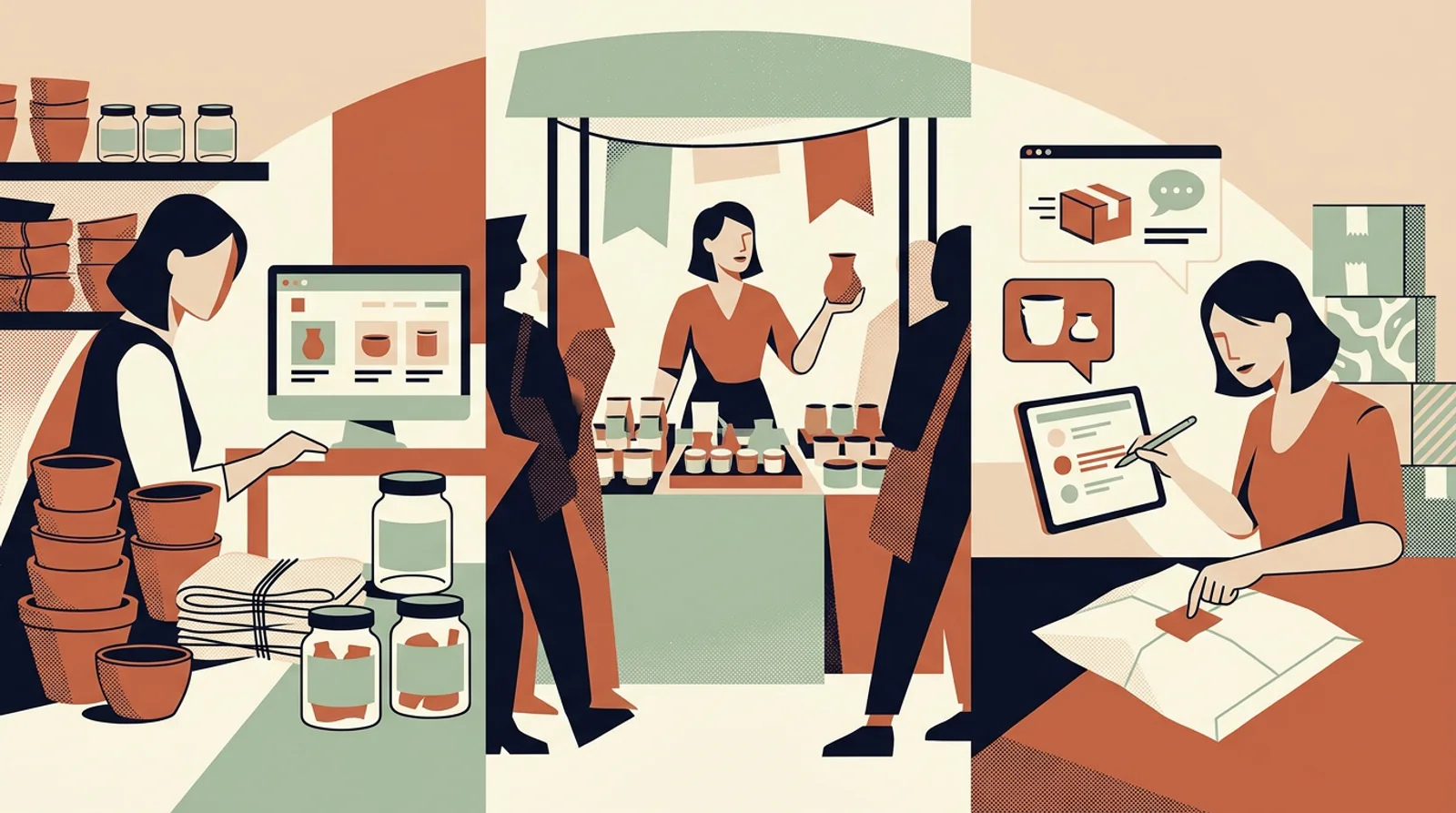
For a maker who sells online and at markets, that day is lived as a thing apart, hanging on the weather and the foot traffic. You make for weeks, you unpack in the morning, you hope. The missing move isn't the making: it's the layer of presence that connects that day to the online shop, where the brand actually grows.

What if your market started before you arrived?
Your online presence can announce your market, ReadyToPost handles it before the day itself.
Announce my marketThe day you book your spot, the market is already planned on the content side. Lay the three beats on your calendar before you make a single post: the before to fill the stall, the during to sell live, the after to convert. A soap maker who locks in her Christmas market date in October has two months to build anticipation, not a story improvised the night before. You don't decide "I'll post something": you already know what, when, and on which network.
Note the 3 beats in your calendar the second you sign up.
Announce your presence and your spot early enough to draw a warm local audience — your followers, your neighborhood, the market regulars. Pull out a photo of a soap or a gift box, turn it into a desirable visual, and give a real reason to come find you: a new piece, a limited run, the scent of the season. The goal isn't "I'll be at the market on the square," it's "come grab THIS product at MY stall." You already have the goods, so you already have the photo: all that's left is to style it.
Put a precise date and place in the visual: people come for an appointment, not for vague info.

During the market, post what's on the table right now: the stack of soaps just unwrapped, the corner you've just set up, you serving a customer if someone can snap you. Your followers who couldn't come live the moment and feel the urgency of a one-day window. It's also the right instinct for Instagram and Facebook, where your audience scrolls. No need to slip away for an hour: a photo taken fast, styled in seconds, and the copy is written for each network while you ring people up.
One post mid-morning and one in early afternoon cover both foot-traffic peaks.
The next day, don't let the encounter fade with the folded-up table. Reach out to the visitors who admired without buying — or who bought once — and send them to your shop. "Did you spot the amber-vanilla candle at the market? It's waiting for you online." A single market day then plants an ongoing relationship: the customer who smelled your soaps becomes an order the following week, then a regular. That's where your shop truly fills up.
Drop the direct link to the product seen at the market, never just "link in bio."
It all comes down to one ritual: you capture, the app styles. Your product photos are often rough — kitchen light, countertop background — and that's exactly what ReadyToPost turns into a branded visual, then dresses with the copy tailored to Instagram, Pinterest and Facebook. Each beat costs minutes, not an evening. Consistency no longer comes from superhuman effort: it comes from a quick move, repeated three times around a single market.
Always keep 2-3 product photos ready on your phone: the raw material for the whole arc.
You sell live from your table, ReadyToPost covers the rest.
Before, during and after your market, ReadyToPost writes and posts to every network, while you stay with your customers.
Cover my marketDo
Don't
Situation
Claire runs a small handmade soap studio and signs up for her town's Christmas makers' market, three weekends before the holidays. Usually she makes her stock in a panic, unpacks Saturday morning, and crosses her fingers.
Action
This time, the moment she signs up, she lays out her three beats. Ten days before, she posts a photo of her discovery gift box styled in a wood-and-candle setting, with the date and the aisle of her stall. On the day, two posts from behind the table: the stacked soaps in the morning, her mid-service in the afternoon. On Monday, a follow-up to her shop for those who smelled but didn't buy. Each post took her the time of a coffee.
Outcome
Customers walk up asking "is that you, the wood gift box?" The stall doesn't empty out during the slow hours because followers came on purpose. And Monday evening, three online orders land from visitors who'd hesitated at the stall. The market was no longer an isolated Saturday, but a week of presence.
A market in three beats, a feed that never stops.
The same arc can carry your next market, from the morning announcement to the follow-up toward your shop.
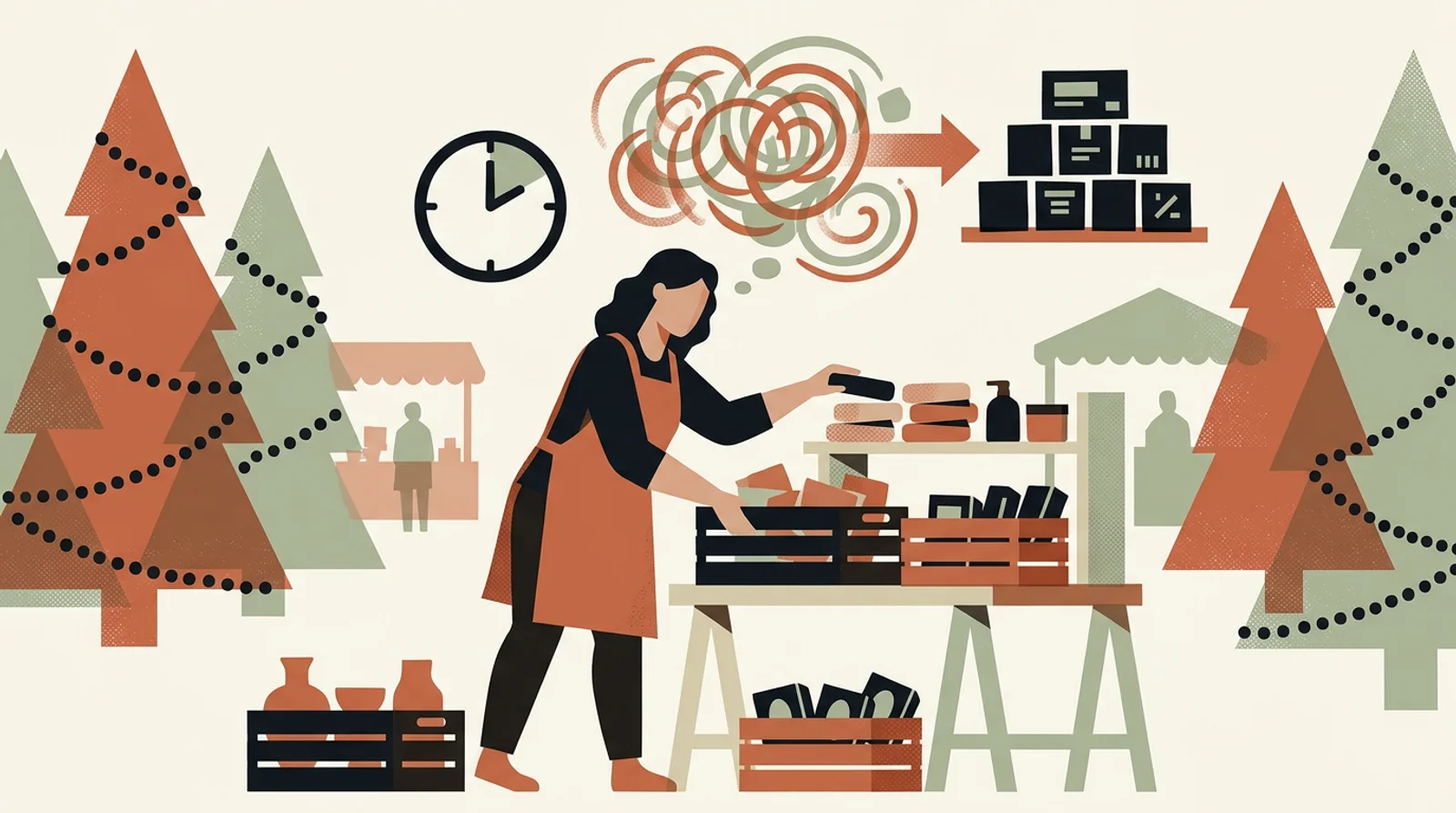
The default instinct is to bet everything on the day of the physical sale and cut it off from your online presence. The result: you unpack cold, no one knows you're there, and the reach you could have built ahead of time doesn't exist. The event isn't a dot on the calendar, it's a window of several days.
The photo of your stall, snapped in a rush against a wobbly table, looks too ugly to publish. So you post nothing. That's exactly what the app fixes: it starts from the real photo, even a mediocre one, and styles it into a branded visual. The product stays yours — it's showcased, not invented. A clean visual in two minutes beats a masterpiece never published.

The costliest trap: putting away your table and considering the market over. The dozens of people who stopped without buying are all nearly-convinced customers, and you have no way to find them again if you didn't post a follow-up. Without the "after" beat, every market starts from scratch instead of feeding your shop.
Pulling these levers every week is already a discipline. Adding communication on five social networks is another — and the one that gets sacrificed first. Readytopost takes the second one off your plate: posts, images, scheduling, calibrated on your work. So the first one keeps all your attention.
Start with ReadyToPostBack to the overview for makers to browse all guides — diagnosis, method, practice — in whichever order fits. Three floors that complement each other: one to understand, one to think, one to act. You go in where it pinches most today, and come back when a new question shows up. No required order.
Back to the overview
Ten days or so is enough for most local markets. That's enough for your followers and your neighborhood to note the date, without the info getting lost in the feed. For a big craft fair or a Christmas market, you can start two to three weeks ahead with one or two reminders. The idea isn't to saturate, but to set a clear appointment people have time to pencil into their weekend.
That's exactly why the move has to take a few seconds. You take a photo of your table between two customers, the app styles it and writes the copy for each network while you serve. Two posts during the day is plenty: one in the morning, one in the afternoon. It's not an hour of marketing mid-market, it's the time of a snapshot slipped in between two sales.
That's exactly the planned starting point. You already have the product, so you already have a real photo, even a rough one. ReadyToPost turns it into a branded visual: staged in a setting, lifestyle composition, text added. The soap, candle or jewelry stays faithfully yours — the app showcases it, it doesn't invent a fake product. A kitchen photo becomes a visual that makes people want to come to the stall.
For a handmade brand, it mostly happens on Instagram, Pinterest and Facebook. Instagram and Facebook carry the before and the during: announcement, live from the stall, the day's urgency. Pinterest works over time and surfaces your products well after the event. ReadyToPost writes the copy tailored to each from the same photo, so you don't rewrite three times or have to choose: the same content goes out calibrated for each network.
The day after the market, post a follow-up that points to the exact product people saw and touched: "did you smell the fig candle at the stall? it's online now." Add a direct link to the product page, not a vague nudge toward the shop. The person who hesitated at your table just needs a second chance to place an order. It's that "after" beat that stretches a one-day encounter into a lasting relationship, and that fills your shop between markets.
Build a useful Instagram foundation before chasing reach: clarify the offer, collect real product proof, give each post a job, and repeat the sequence.

Choose one Etsy listing, give each week a clear buyer job, and turn accurate product facts and photos into a connected Instagram campaign.

Sell a digital download on Etsy by solving one buyer task, packaging the files clearly, publishing a complete digital listing, and promoting the offer with a repeatable proof sequence.
Promote your Etsy shop by showing the product, process and person behind it consistently, using material that already exists in your business.
Most lists of artist content ideas ignore what you actually sell. Originals, prints, commissions and classes each need different posts. The four compared, with ideas for each.
One Etsy listing can support several useful Pins. Give each Pin a distinct buying question, a clear destination and a reason to open the product page.

From a single website URL, ReadyToPost builds your brand profile and starts generating on-brand posts — no manual brief to fill.
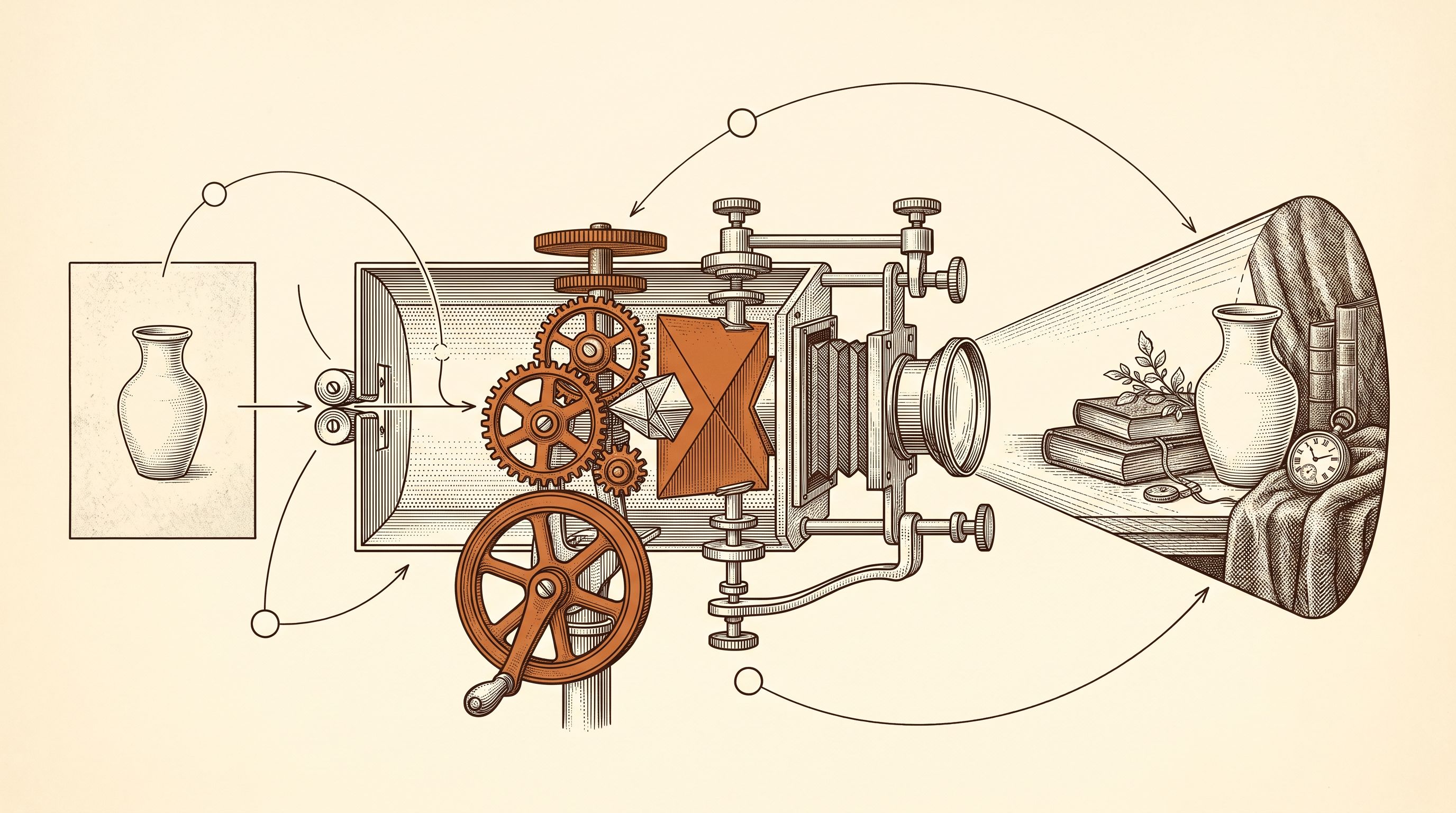
Generate social visuals from your real photos — in your style and fonts, in the right format per network. Fix any detail in one sentence.
A semantic memory of your brand's real facts, so every post cites what you actually do and have.
Generate on-brand Instagram posts where the 4:5 feed visual and the caption are built together — a scroll-stopping hook, breathable paragraphs, and full-word hashtags grouped at the end, scheduled and ready to publish.
Generate professional LinkedIn posts, mention real people and companies right in the text, then publish to your profile or your company page.
Generate conversational Facebook posts, set your emoji and hashtag level, and schedule them straight to your Facebook Page. Text and visual built for the feed.
You know what to pull each week. Readytopost takes care of the consistency of your communication — your energy stays on the floor.
Monthly plansReady in minutesCancel in one click