


In practice · Push direct bookings

Push direct bookings: 5 moves over 7 days

Each direct point is worth 13 margin points. The math pays — provided you don't break the rate.
the margin gained per room when a guest books direct with -5% vs OTA at 18% commission.
The setup

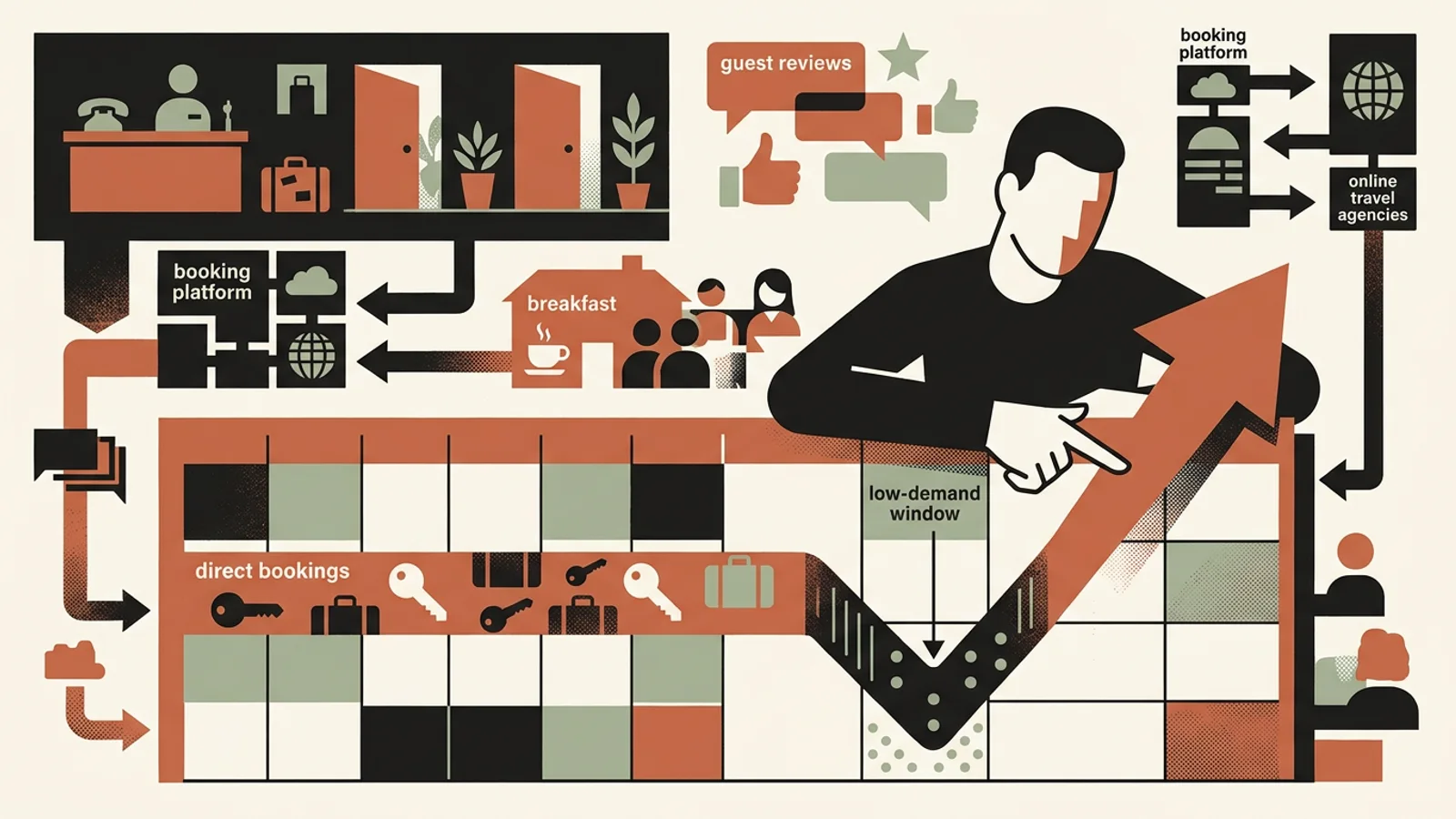
A hotel doesn''t turn around in one big move — it turns around through fifty small moves placed where they touch something. A direct booking push over 7-14 days isn''t a marketing campaign: it''s a coordination of five internal levers (team, mail signature, guest base, Google listing, social) over a short window, to push direct booking without slashing the room or devaluing the published rate. Five moves placed this fortnight, readable in the direct mix from the next month.

Symptoms

You might recognise these signs.

  • OTA mix sits at 63-71% for 18 months even though the independent segment average is 58% — you pay 14-22k€ commission a year on 14 rooms.
  • Average OTA commission is 18% (Booking 15%, Expedia up to 25%) against 4-5% direct cost (engine, payment, fraud) — each direct point gained is worth 13 margin points.
  • You know the direct window pays better, but no mechanic is in place to encourage it — no ''best rate'' button, no clear benefit, no active communication.
  • OTA cancellations sit at 21.8% vs 10.6% direct — every direct booking is also mechanically more stable, which helps piloting.
  • The front desk email signature doesn''t mention the direct site; the Google listing has no booking button; social posts link to Booking. Everything pushes to OTA without meaning to.
Method

Step by step.

  1. Monday morning: calculate the profitable ratio and name the operation.

    Three lines on a sheet. Average room rate: 145€ per night. Average OTA commission: 18% = 26€ per night. Direct cost: 4.5% = 6.50€ per night. Differential margin direct vs OTA: 19.50€ per night, 13 points. You can therefore offer up to 13% direct discount and stay as profitable as OTA — the comfortable zone is between 5 and 10%. Name the operation precisely: ''From November 1 to 14, direct rate -8% reserved for stays booked on our site, best price guarantee included.'' Not ''November direct'', not ''our autumn operation''. One window, one numbered advantage, one channel. The fond analysis discipline is framed in Measuring OTA dependency.

    Check your contractual rate parity with Booking and Expedia before publicly advertising the direct rate. The ''-8% direct only'' can be communicated as a private advantage (mail signature, guest base) without breaking public parity on comparators.

  2. Monday afternoon: build the direct offer as a basket, not as a discount.

    An 8% discount alone is invisible on the booking engine and often disappoints (''we went through Booking for €5 difference''). Build instead a basket that only exists direct: ''-8% + breakfast included + late check-out 2pm + welcome drink''. Marginal cost for you: 4-6€ per night (breakfast offered on guests who would have paid 12€ for it), but perceived value is 25-30€. You avoid 18% OTA commission while giving an advantage the guest talks about. The decisive lever isn''t the unit rate — it''s the global basket. This mechanic ties into Making them return: perceived value is built by what you add, not what you take off.

    Late check-out is the lever that costs the least (a bit of housekeeping management) and pleases the most business travellers. Always put it in the direct basket.

  3. Tuesday: deploy 5 visibility points over 7 days.

    Five visibility points, not ten. (1) Mail signature of the entire team (front desk, management, housekeeping) with a line added during the window: ''-8% + breakfast included on direct bookings November 1-14 — [direct link]''. (2) Google Business listing: an ''Offer'' post with recent photo, mention of ''direct rate'' and booking button pointing to your engine, not Booking. (3) Banner on your site''s home page: a discreet top strip, not an intrusive popup. (4) Individual message to the 50-80 guests in your base from the last 24 months: short email, signed by the manager, mentioning the window and the advantage. (5) The same post adapted to all 5 networks (Instagram, LinkedIn, Facebook, Pinterest, X) with a recent room photo and direct link — maximum coverage in one effort. The direct link goes in the first line of the post, not in the bio. Otherwise the post builds brand, not bookings.

    The mail signature is the most under-used and most powerful lever. On 14 rooms with 8-12 emails per day going out from front desk, that''s 70 exposures per week — at zero modification cost.

  4. Wednesday: brief the front desk on the direct pitch.

    The front desk talks to prospects every day who call or write. They need to know in two sentences why direct pays better for the guest (added basket, best price guarantee, direct contact in case of need) and how to say it without commercial aggression. 15-minute brief, Monday or Tuesday: the window, the numbered advantage, the template sentence (''If you book on our site, you get breakfast included and check-out at 2pm — that''s our direct offer this fortnight''). No script to recite — a two-sentence pitch, naturally integrated into the conversation. Without that alignment, the prospect calls, is advised, then hangs up and books on Booking out of habit. This team discipline is framed in Reading team signals.

    Measure inbound calls during the window: how many convert to direct booking same day. Without that measurement, the team doesn''t know whether they flipped the prospect or lost the conversation.

  5. Sunday evening D+7: measure 3 indicators and decide the next step.

    At the end of the first week, count three numbers. (1) Incremental direct room-nights versus same week N-1 — e.g. +8 direct room-nights over 7 days. (2) Direct mix on the window vs annual mix — moving from 37% to 52% is a clean success. (3) Margin gained: incremental direct room-nights × differential margin (+19.50€ per night). On 8 incremental direct room-nights, that''s 156€ extra margin per week, excluding the basket. If numbers move in the right direction, extend the second week by varying communication (renewed Google post, second email to another base segment). If nothing moves by D+7, the advantage isn''t legible enough or the channels aren''t hitting the target — adjust the basket (add a treatment or a local visit) before stopping.

Do / Don't

Do

  • Calculate differential margin direct vs OTA before setting the percentage — comfortable zone is 5-10% direct discount.
  • Build a basket (discount + breakfast + late check-out + drink) rather than a bare discount, to value without devaluing.
  • Coordinate 5 fixed visibility points: mail signature, Google listing, site, guest base, presence across the 5 networks.

Don't

  • Publicly advertise a direct rate lower than the OTA rate without checking your rate parity — private communication only (mail signature, base).
  • Launch the operation over 30 days — the short window (7-14 days) creates the urgency that flips the hesitant prospect.
  • Slash the room at -25% — you kill perceived value for 3 months and earn less than what a basket at -8% would have brought.
A concrete case

Situation

A 4-star 16-room boutique hotel (Annecy) runs 65% OTA mix yearly, mainly Booking. Average rate 178€, Booking commission 17%, 30€ per night. Direct mix stagnates at 35% for three years. The manager spots a 14-day hollow in November (pickup at -22% vs N-1).

Action

Monday November 1, ratio calculation: differential margin 24€ per night, comfortable zone up to -13%. The manager sets the operation at ''-8% + breakfast included (value 16€) + check-out 2pm''. From November 4 to 17, communicated exclusively in mail signature (8 people), Google listing (Offer post, photo of lake in autumn), site banner, email to 67 base guests from the last 24 months (signed manager''s first name), the same post adapted to all 5 networks (Instagram, LinkedIn, Facebook, Pinterest, X) with photo of reception decorated for autumn. 15-minute brief Tuesday morning with front desk: two-sentence pitch on direct advantage.

Outcome

D+14 balance: 31 incremental direct room-nights against 12 same fortnight N-1, +19 direct room-nights. Direct mix on window up to 58% (vs 35% current year). Differential margin gained: 19 × 24€ = 456€, plus unused basket on 4 room-nights (guests who didn''t take breakfast) = 520€ total. Seven bookings came by phone after front desk mentioned the direct advantage — without the brief, they''d have gone through Booking. The manager extends the mechanic in December on the same base, without mass announcement — just maintained mail signature and Google listing.

Common pitfalls

Where it usually goes wrong.

  • Breaking contractual rate parity by publicly displaying a lower direct rate.

    Booking and Expedia have rate parity clauses in their contracts. Publicly displaying a direct rate at -8% on your site can demote your listing in their results — you lose OTA visibility for what you gain direct, possibly more. The workaround: communicate the direct advantage privately (mail signature, guest base, phone contact), keep the same rate on the public booking engine, apply the discount by code or added basket. ''-8%'' becomes a relationship advantage, not a published rate. This nuance is what separates a winning operation from one that destroys overall visibility.

  • Running the operation over 30 days ''to have time''.

    Past 14 days, the advantage becomes a permanent rate in the guest''s head — they wait for the next operation to book, the normal rate reads as a hike, and the Google ''Offer'' post expires fading without renewal. The short window (7-14 days, ideally 10) creates the urgency that flips hesitant prospects. Announcing the end date in the first communication is what triggers the booking. This short-window logic is framed in Rescuing a slow week — same mechanic, different objective.

  • Ignoring the front desk brief thinking digital communication will be enough.

    The front desk handles 8-15 prospect calls and emails per day. Without a brief on the direct pitch, those conversations almost all end in OTA booking out of habit (''you can book on Booking, see you soon''). With a two-sentence pitch — the direct advantage, the link to send — 30 to 40% of those conversations flip direct. Over 14 operation days with 100 inbound contacts, that''s 30 to 40 bookings won direct instead of OTA, 600-800€ extra margin. The phone conversation is the most powerful and most under-used lever.

Takeaway

Your checklist.

  • Profitable ratio calculated: differential margin direct vs OTA per night, comfortable zone 5-10% direct discount.
  • Offer is a basket (discount + breakfast + late check-out + drink), not a bare discount.
  • Window is named precisely: start date, end date, duration between 7 and 14 days.
  • Five fixed visibility points activated: mail signature, Google 'Offer' listing, site banner, guest base email, presence across the 5 networks.
  • Contractual rate parity respected — direct advantage communicated privately, not publicly displayed.
  • Front desk briefed 15 minutes on the direct pitch in two sentences before window opens.
What's next?

Levers spotted. Now pull them weekly.

Pulling these levers every week is already a discipline. Adding communication on five social networks is another — and the one that gets sacrificed first. Readytopost takes the second one off your plate: posts, images, scheduling, calibrated on your hotel. So the first one keeps all your attention.

Start with ReadyToPost

Back to the overview for independent hotels to browse all guides — diagnosis, method, practice — in whichever order fits. Three floors that complement each other: one to understand, one to think, one to act. You go in where it pinches most today, and come back when a new question shows up. No required order.

Back to the overview
hotel

Other guides for independent hotels

Weekly piloting for indie hotels

Four Monday indicators: piloting a boutique property

Four indicators read every Monday are enough to pilot an independent hotel. Not ten, not twenty: four — pickup J+7 vs J+30, ADR vs local market, direct/OTA channel mix, review sentiment last 7 days. Each triggers a clear decision at every reading. The rest is dashboard that reassures without changing anything. And it all fits in a shared spreadsheet — no €400/month revenue manager required.

Come back every year

The method for guests who come back every year

In hotels, the guest who returns a second time costs almost nothing to acquire — no OTA commission, no campaign, no Booking discount. And they're worth five times the margin of a new guest captured at 18% commission. Yet most independent hotels pilot acquisition and forget the cadence of return. A word, an attention, a well-placed email is enough — but it has to land at the right time.

Arrival weighs 80% of the stay

Arrival matters: the moment of truth in a small hotel

A guest decides their Booking score within the first twenty minutes: the pre-stay email they received, the smile at the front desk, the first five seconds in the room, the bathroom smell. The rest of the stay confirms or nuances — it no longer overturns. Everything that plays out before and at arrival weighs more than pillow quality or balcony view.

Pick a guest type to serve

Picking the guest type you serve: the pivot decision

With 20 keys, chasing the weekend couple and the Tuesday business traveller at once means serving both badly. Naming one or two guest moments — short weekend, mid-week business, family long-stay, 7+ night digital nomad — is the call that aligns the breakfast offer, the front-desk tone and the rate quoted direct.

Further reading

Related blog articles

  • case-studies

    A boutique hotel reclaims its margins

    No pro shoots. No agency. Just iPhone photos taken between two services, processed differently. Six months later, the numbers shift.

  • social-media-strategy

    Google is ending its search bar.

    Google rebuilt the search bar as an AI agent. The click on the top organic result already dropped 58 percent. For an independent, the marketing minutes shift from SEO long-tail to social presence, the field where your name still gets remembered.

  • case-studies

    The product photo threshold

    A product photo on a plain background gets catalog reach. The same product photographed in context gets saved. Here is where that line sits.

  • content-creation

    When the image says one thing

    The most common failure in a social post is not the caption. It is the gap between what the image shows and what the text claims.

Questions

Frequently asked.

  • What direct discount percentage is profitable against OTA commission?

    Simple math. Average Booking commission: 15-17%. Expedia commission up to 25%. Direct cost (engine, payment, fraud, marketing): 4-5%. Differential margin direct vs OTA: 10 to 20 points depending on your OTA channel mix. The comfortable direct discount zone is between 5 and 10% — you keep a margin distinctly higher than OTA while giving a visible advantage. Past 13% direct discount, you earn less than OTA and additionally devalue your published rate for the following weeks. Rule: calculate once, set the comfortable window, never go below it for volume — volume without margin doesn''t pay fixed costs.

  • Can you publicly display a direct rate lower than the OTA rate?

    No, not without precaution. Booking and Expedia have rate parity clauses in their hotel contracts. Publicly displaying a direct rate at -8% can demote your listing in their search results, possibly suspending temporary commercialisation. The workaround: communicate the direct advantage privately (mail signature, guest base, phone contact), keep the same unit rate on the public booking engine, apply the discount by promotional code or added basket (breakfast included, late check-out). You gain margin without breaking OTA visibility. Check the exact clauses in your contracts — they vary by seniority and country.

  • How many incremental direct room-nights to expect on a 14-day operation?

    Order of magnitude observed on a 10-25 room independent hotel with 60-70% OTA mix: +12 to +25 incremental direct room-nights over 14 days, compared to same fortnight N-1. Direct mix on the window typically moves from 30-35% to 50-58%. Margin gained sits between 300 and 800€ depending on average rate and basket. Beyond that, you''re catching a favourable seasonal effect (school holidays, local event) on top of the operation — not just direct push. Below +5 room-nights, the operation didn''t hit its target — adjust the basket or reframe the window. The fond measurement discipline is framed in [Piloting](/en/resources/hotel/method/hotel-piloting).

  • Should you run direct operations multiple times a year?

    Yes, ideally four times a year, over short windows (10-14 days), spaced and aligned on hollows or seasonal transitions. Too frequent (monthly), the operation becomes routine and loses its window effect. Too spaced (once a year), it doesn''t durably shift the mix. Four times — e.g. early February, early June, early October, mid-December — progressively installs the direct reflex with loyal guests, while keeping the ''event'' effect at each edition. Vary the basket angle: breakfast included in winter, regional welcome basket in summer, late check-out plus spa access in autumn. Long-term objective is to durably flip your direct mix from 35% to 45-50%, which takes 18-24 months of regular discipline. This long-term logic is framed in [Choosing a guest type](/en/resources/hotel/method/pick-a-guest).

  • Should the direct operation be communicated on Booking too, for visibility?

    No, and it''s counter-productive. Communicating a ''direct offer'' on the Booking listing catches the guest''s eye but also tells them direct booking is cheaper — Booking then degrades your position in results (rate parity algorithm) and you lose OTA visibility, without mechanically gaining direct. Rule: Booking serves to attract the guest''s first stay; direct operations serve to retain the second and following. On the Booking listing, communicate on quality (recent photos, polished description, replies to reviews), not direct advantages. The latter are communicated only to guests already came (base) or to prospects contacting you directly (phone, email).