
Method · Pick a guest type to serve

Pick a guest type: the decision that aligns room, welcome and price

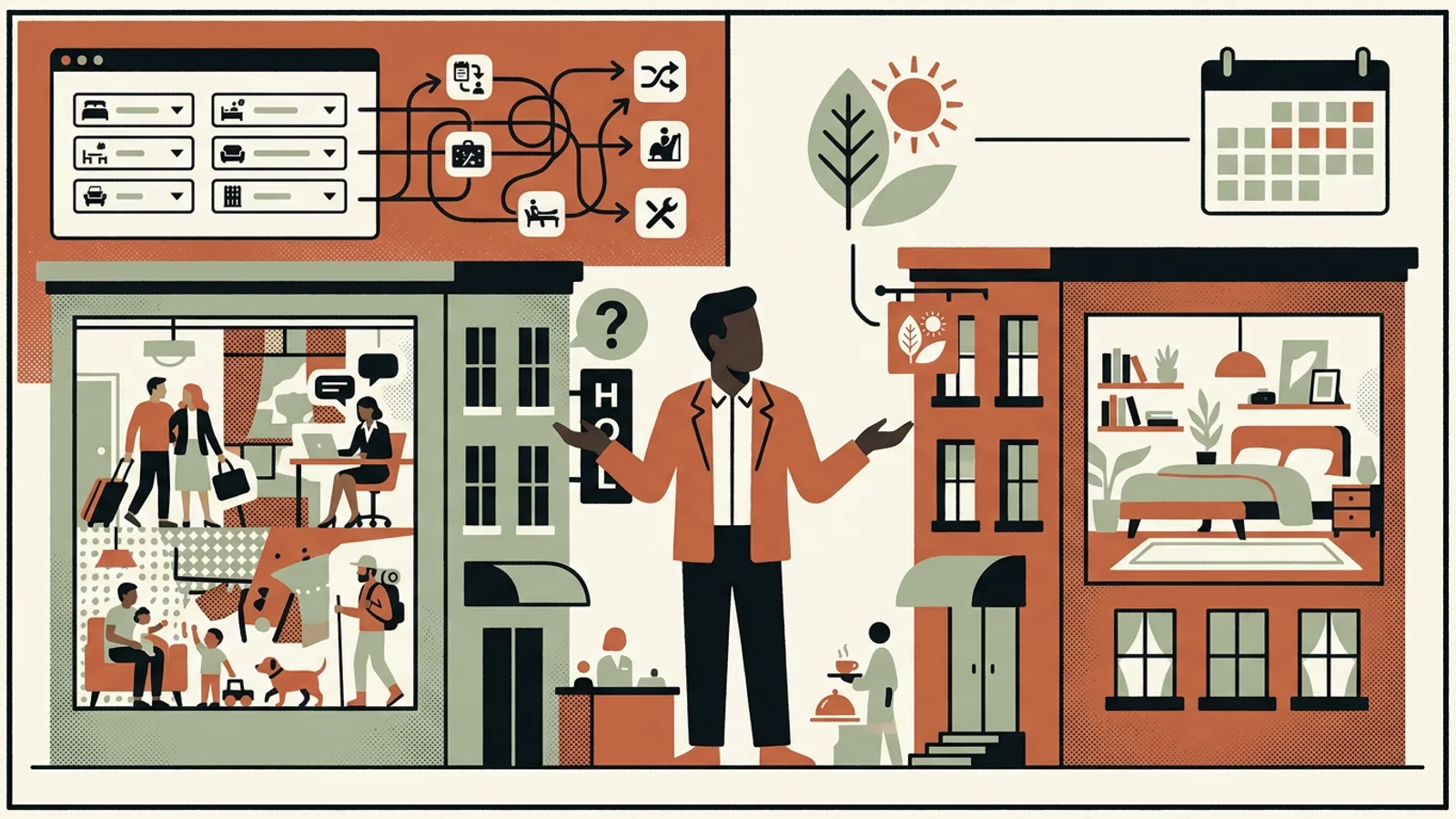
A hotel trying to please the weekend couple AND the Tuesday salesman serves both badly — fuzziness has a price.
guest moments maximum a 3-30 room boutique can serve coherently before things start to drift.
The setup

_Method isn''t an annual plan — it''s the quarterly step back that makes decisions hold past the weekend._ Of all those decisions, picking a guest type is the one that aligns the others. As long as it isn''t made, the room is laid out in a vacuum, breakfast wavers between family buffet and room-service tray, pricing oscillates between business ADR and weekend rate. The silent cost of fuzziness shows up in occupancy.

Symptoms

You might recognise these signs.

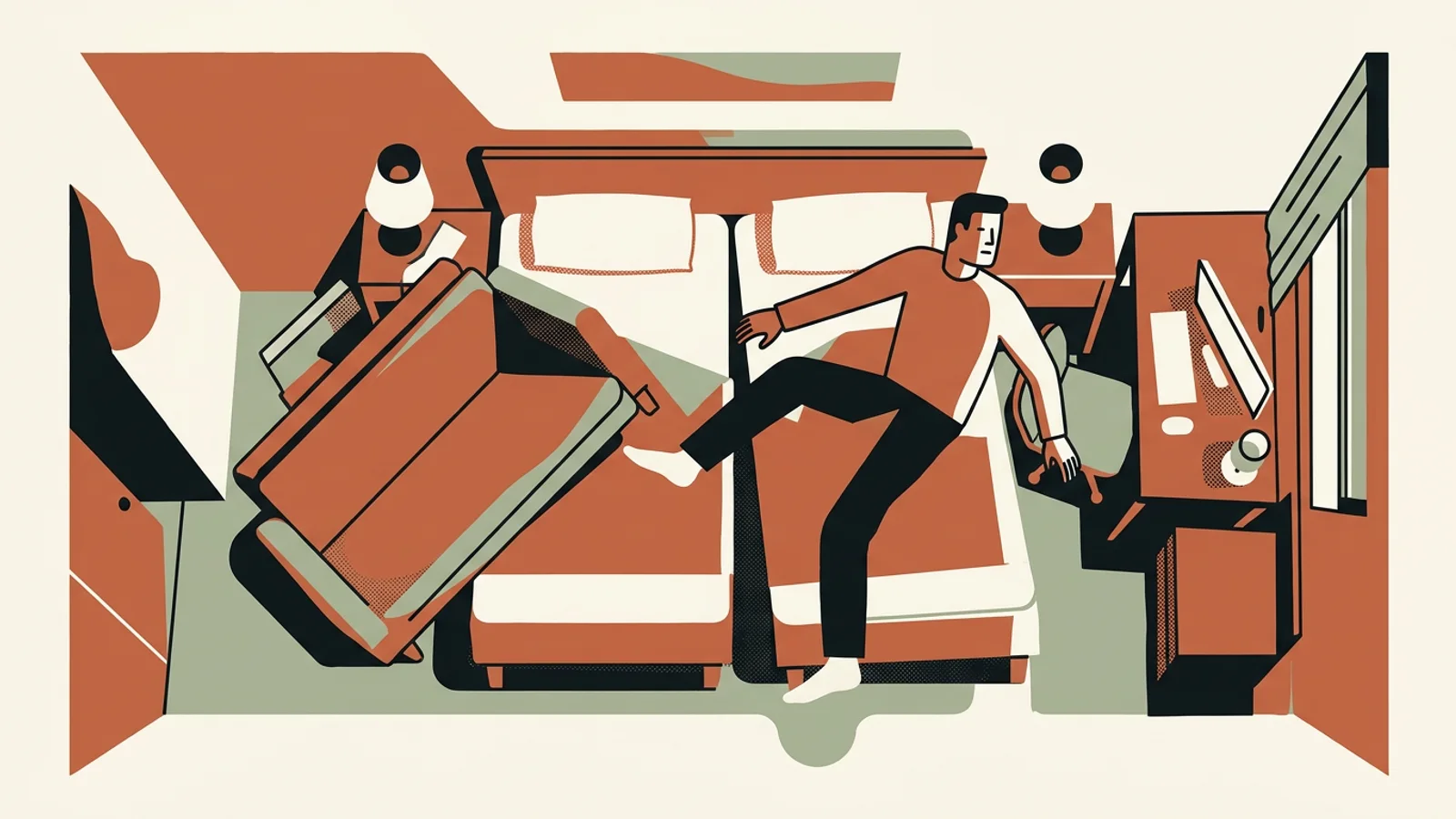
  • The room tries to do everything: a king bed that splits into twins, a sofa that folds out, a workspace squeezed by the window — every profile finds a compromise, no one feels at home.
  • Booking reviews are scattered: some talk about a romantic weekend, others a family stay with toddlers, others a business stopover — no single moment becomes yours.
  • The front desk team doesn''t know which register to use: relaxed first-name or formal, suggesting activities or staying discreet. The tone shifts with whoever walks in.
  • You attract very different guest profiles, but none returns often enough to become a marker — the second visit, which is 5× more profitable than acquisition, never kicks in.
  • When someone asks ''who exactly do you serve?'', you answer with a list of options (''couples, business, families, groups''), never with a specific moment.
Method

Step by step.

  1. Describe the moment, not the person.

    A guest isn''t defined by social bracket or nationality — a 45-year-old executive can come on a business short-stay in March and return for a couples weekend in June. Two guest moments, same body. The real unit of choice is the moment: couples weekend 1-2 nights, business short-stay 2-3 nights, family long-stay 4-7 nights, digital nomad 7+ nights, wellness or treatment stay. Each moment has its own constraints — duration, room equipment, breakfast format, type of welcome. Once the moment is set, everything follows: from pillow choice to the rate grid.

    If you''re unsure, look at your last 30 direct bookings: which moment recurs without you having forced anything? That''s usually the one you serve best — the deeper read sits in [Reading occupancy](/en/resources/hotel/diagnosis/read-the-occupancy).

  2. Look at who already returns, not who you''d like to attract.

    The paper-ideal guest is often a mirage. The real guest is the one who returns — and they''re rarely the one you imagined. Pull up the names that show twice in the past twelve months in your PMS or your booking book. That group is your effective clientele, whether or not it matches your imagined target. On a 12-room hotel in Vendée that pictured itself as ''weekend romance'', it''s sometimes six families of returning summer regulars who actually carry the year. Method starts by accepting that starting point.

  3. Make choices that show up in the room.

    Picking a guest type without the room reflecting it is not picking. If you target the couples weekend two-nighter, the room has to say so: a fixed king bed (no convertible twin), a bathroom designed for two, dimmable lighting, a kettle that echoes a late breakfast. If you target business short-stay, the opposite — a workable desk with USB at hand, near-daylight white light, a fast high-pressure shower, late check-in possible until 11pm. The room speaks louder than the website: a guest walking in reads your choice before exchanging a single word with reception.

    The simple test: hand your 30 room photos to a neighbour and ask ''who is this for?''. If they hesitate, the choice isn''t visible yet.

  4. Accept disappointing some profiles.

    Choosing means rejecting. As long as no guest says ''this wasn''t the hotel for me'', you haven''t really chosen. An 8-room boutique built for couples weekend is not the right venue for a 12-person corporate offsite — and that''s perfectly fine. The fear of losing the 15% off-target guests is what makes operators give up on the 60% they could deeply settle into. It''s the inverse arithmetic of intuition, and it''s the one that fills the soft midweek. The logic ties back to Make guests return: a guest who isn''t in your moment won''t come back three times, even well served.

  5. Test the ''no'' over a quarter.

    A choice that never translates into a refusal or a redirection isn''t a choice. Over a quarter, ask the concrete question: which booking types did I decline, which groups did I redirect to a better-equipped colleague, which equipment did I retire (the cot beds, the high-chair box gathering dust)? If the answer is nothing, the guest type hasn''t been picked — it''s just been described. The quarter is the right unit: long enough to read effect on occupancy and RevPAR, short enough to correct without drama.

Do / Don't

Do

  • Describe your guest with one or two specific moments (couples weekend, business short-stay), not a social bracket or age range.
  • Align the room and the breakfast on that choice before touching marketing — coherence reads first at the door.
  • Accept losing 10-15% of off-target bookings to solidify the 60-70% that fit.

Don't

  • Confuse marketing persona and served guest type — a persona is a tool, a guest type is an operational decision.
  • Try to target more than three distinct moments in the week — beyond that, the room becomes a compromise and the team loses the tone.
  • Define your guest by exclusion (''we''re not a chain'') without saying positively which moment you exist for.
A concrete case

Situation

Two boutique hotels in Burgundy, same village, 9 and 11 rooms, same price range (€130-180/night). Hotel A has one clearly identified room type: fixed 180 king bed, exposed-stone bathroom, kettle and teas, no desk. Hotel B offers a modular room: bed splittable into twins, sofa-bed for one child, foldaway desk. Same professional photography, same star rating.

Action

A has chosen: couples weekend two nights, Friday to Sunday. Breakfast served at table until 11am, valley walks and nearby chambres d''hôtes suggested at reception, no play area, no kids menu. A declines corporate retreat requests and redirects two-child families to an inn 6 km away that''s better equipped. B accepts everything: couples, families, Tuesday business stays, Saturday cycling groups. Breakfast buffet served 7am-10am to fit everyone, the room reconfigured between every guest.

Outcome

Over twelve months, A holds weekend occupancy at 88% with an average ADR of €165, a direct booking rate of 47% (vs 30% for the independent market average). Reviews converge: ''perfect for a couples weekend'', and the returning guest has settled in — a third of the 2026 base has already stayed once. B sits at 62% overall occupancy, ADR €142, OTA mix at 71%. Booking reviews talk about five different experiences without any standing out — and the second-visit guest, who weighs 5× more profitable than acquisition, never settles in. It''s not the room quality that separates the two — it''s the guest decision and everything it cascades.

Common pitfalls

Where it usually goes wrong.

  • Confusing persona and served guest type.

    A persona is a descriptive sheet — age, nationality, budget, travel motivations. Useful for steering tone across the 5 networks where you post, useless for deciding pillow choice or breakfast hours. A guest type, on the operational side, is a moment plus a need: ''the Paris-based couple coming down two nights for their tenth anniversary, arriving Friday 6pm by train, leaving Sunday 4pm, eating out Saturday night''. The persona sheet says nothing about late check-in or the bathroom layout for two. The moment says everything — and the moment is what structures the hotel.

  • Believing you can serve every profile.

    The argument sounds obvious — why turn away bookings? But it forgets that serving multiple types well requires different rooms, different breakfasts, different welcome windows — therefore different hotels. Even chains segment: a Premier Inn isn''t an Ibis Styles isn''t a Pullman. A 3-30 room independent doesn''t have more resources than them to hold three concepts under the same roof. Soft ''everyone'' kills more boutique hotels than OTAs do — it splinters effort across ten axes and carries none of them. The empty Tuesday is almost always the cost of that indecision.

  • Defining your guest by exclusion without owning it.

    ''We''re not a chain'' isn''t a positioning, it''s a wall. For a guest choice to bear fruit, it has to be stated positively: which moment you exist for, for whom, at what level of service. Exclusion alone produces hotels defined by what they aren''t — and ending up as nothing specific. Choosing is saying yes to a moment, not just no to many. The nuance changes the homepage wording, the lead photo, and the first sentence at reception.

Takeaway

Your checklist.

  • Which specific moment(s) do you serve best — one, two, at most three across the week and the year.
  • Does the standard room clearly reflect that moment — bed, bathroom, workspace, lighting.
  • Of your last 30 direct bookings, how many match the chosen guest versus how many are off-target.
  • Which booking requests have you declined or redirected this quarter — proof a choice was made.
  • Do your returning guests return for the same moment, or for scattered occasions.
  • If you asked your receptionist to describe your typical guest in one sentence, would they have it ready.
What's next?

Method in hand. Time to put it to work.

A method is set — still, you need time to put it to work. Readytopost frees that time by taking one front off your plate: your presence on the five social networks. Everything written, illustrated, scheduled — calibrated on your hotel, week after week. So your energy stays on the trade.

Start with ReadyToPost

See how these principles play out day to day. Practice for independent hotels gives you concrete, illustrated, adaptable levers — directly applicable the following week. No quarterly plans, no annual roadmaps: weekly gestures that touch something right away.

See it in practice
hotel

Other guides for independent hotels

Weekly piloting for indie hotels

Four Monday indicators: piloting a boutique property

Four indicators read every Monday are enough to pilot an independent hotel. Not ten, not twenty: four — pickup J+7 vs J+30, ADR vs local market, direct/OTA channel mix, review sentiment last 7 days. Each triggers a clear decision at every reading. The rest is dashboard that reassures without changing anything. And it all fits in a shared spreadsheet — no €400/month revenue manager required.

Come back every year

The method for guests who come back every year

In hotels, the guest who returns a second time costs almost nothing to acquire — no OTA commission, no campaign, no Booking discount. And they're worth five times the margin of a new guest captured at 18% commission. Yet most independent hotels pilot acquisition and forget the cadence of return. A word, an attention, a well-placed email is enough — but it has to land at the right time.

Arrival weighs 80% of the stay

Arrival matters: the moment of truth in a small hotel

A guest decides their Booking score within the first twenty minutes: the pre-stay email they received, the smile at the front desk, the first five seconds in the room, the bathroom smell. The rest of the stay confirms or nuances — it no longer overturns. Everything that plays out before and at arrival weighs more than pillow quality or balcony view.

Push direct bookings

Push direct bookings: 5 moves over 7 days

OTA at 63% of mix, 18% commission: each point gained in direct is worth 14% more net revenue. Five moves placed over 7-14 days to push direct booking without destroying room value.

Further reading

Related blog articles

  • case-studies

    A boutique hotel reclaims its margins

    No pro shoots. No agency. Just iPhone photos taken between two services, processed differently. Six months later, the numbers shift.

  • case-studies

    From idea to launched

    You have a new offer, a new season, or a new product. You need five networks to know. Here is the exact sequence, from idea to shipped posts.

  • ai-tools

    5 changes in Google search, explained

    The new Search isn't one product. It's five distinct launches stacked into one announcement, each with its own pricing and rollout schedule. Here is what Google actually shipped at I/O 2026, piece by piece.

  • social-media-strategy

    Google is ending its search bar.

    Google rebuilt the search bar as an AI agent. The click on the top organic result already dropped 58 percent. For an independent, the marketing minutes shift from SEO long-tail to social presence, the field where your name still gets remembered.

Questions

Frequently asked.

  • How do you pick the right guest type for an independent hotel?

    The right guest isn''t the one who pays the most — it''s the one you want to welcome three times a month. Start with the weekends or weekdays that fill naturally and the names that keep coming back — that''s your effective clientele. Then check you can serve them coherently: aligned room, suitable breakfast, team at ease with the register. If yes, you''ve got your choice. If not, two options: adjust the hotel to the observed guest, or reposition the hotel to aim at a guest that fits better.

  • Do I need to define a persona for a hotel?

    The persona is a marketing tool, not a hotel decision. It helps steer a tone across your 5-network presence (Instagram, LinkedIn, Facebook, Pinterest, X), not arbitrate the room format or the check-in window. The right unit is the served moment — couples weekend, business short-stay, family long-stay. The moment dictates duration, equipment, tone, price. The same person shifts moments within the same year, so defining by person rather than by moment misses the real decision.

  • Can you target several guest types in the same hotel?

    Yes, provided they don''t collide in the same service or season. An 18-room seaside hotel can serve couples weekend off-season (October-April, Friday-Sunday) and family long-stay in July-August. Two moments, two seasons, two possible room configurations. Beyond three distinct moments across the year, coherence collapses: the room juggles too many codes, the team loses its register, breakfast becomes a permanent compromise. Three moments max, ideally two, and always tied to specific seasonality.

  • How do I know if my current guest type is the right one?

    Three reads. First, do they return? A guest who doesn''t settle into a second visit isn''t yours, even if they fill the room once. Second, does it match what you''re happy to serve every day? A profitable but draining guest isn''t a 5-year proposition. Third, do your best nights match? If the nights that work best fill with a guest you hadn''t chosen, that''s the right one — your intuition was just faster than your theory.

  • What signals indicate my hotel has no clear guest type?

    Four signals stacking up. Booking reviews talk about very different moments (romantic weekend, family stay, business stopover) without any dominating. The room tries to cover every case — splittable bed, sofa-bed, foldaway desk. The reception team hesitates on the tone to take with each guest. And when asked who you serve, you answer with a list of options. The more these signals stack, the fuzzier the guest type — and the more fuzziness costs in soft nights and an OTA mix that creeps up.