
Method · Come back every year

The method for guests who come back every year

The second-visit guest is worth five new guests captured via OTA. And nobody works on them.
the margin ratio between a returning guest and a new guest captured via OTA at 18% commission.
The setup

_Method isn''t a quarterly promo — it''s the step back that decides where to spend energy when you can''t do everything._ In an indie hotel, energy pays five times more on the guest who might return than on the new guest to conquer. Not a slogan — the arithmetic of the OTA mix. At 18% average commission and 21.8% OTA cancellation rate, the captured guest costs a lot before even setting foot in the room.

Symptoms

You might recognise these signs.

  • Your guests rarely come back — under 15% have a second stay within twelve months, even though the hotel ran at 75% occupancy last year.
  • You can''t say who among last year''s guests had come once, twice, or never before — your PMS and Booking files don''t cross.
  • When a guest leaves Sunday saying ''we''ll be back!'', you don''t know if it''s politeness or a signal — and you have no framework to find out.
  • You work acquisition (Meta Ads, local SEO, tourism office partnership) but no mechanic touches the guest who already stayed last year.
  • When you run an off-season promo, it goes to the wider public via Booking — never to your existing guest file.
Method

Step by step.

  1. Recognise that hotel loyalty runs on an annual cadence, not monthly.

    A neighbourhood restaurant can expect its regular every week — loyalty is monthly. A hotel, no. Most boutique-hotel guests won''t return more than once a year — even very satisfied ones. The right horizon isn''t the month but the year, sometimes two. That difference changes everything: you don''t over-solicit a guest every quarter, you build a relationship that holds over time. One email a year signed with a first name at the right season is more powerful than ten automated monthly newsletters. The annual cadence also follows the guest''s travel motives — a couple who came in November for their tenth anniversary is probably one to relaunch next September, not next March.

  2. Distinguish loyal guest from referring guest — two different levers.

    A loyal guest returns. A referring guest doesn''t necessarily return, but they talk about you. Both matter, they aren''t worked the same way. The loyal guest expects attention on return: ''lovely to see you again, Mrs Lefèvre, the same room as last year?'' — memory creates loyalty, not a points programme. The referring guest expects something to tell — an unusual attention during the stay, a hand-signed card, a small note found on the bedside table. On a 12-room hotel, the loyalty lever brings back 4-6 guests a year; the referral lever brings 8-12 new guests through word of mouth. Both matter — but they aren''t the same work.

    Ask yourself the simple question at the end of every quarter: how many of my guests returned, how many referred. If the second category is invisible, you may be working loyalty at the expense of the experience that gets told.

  3. Keep a light database — paper or spreadsheet beats a CRM at first.

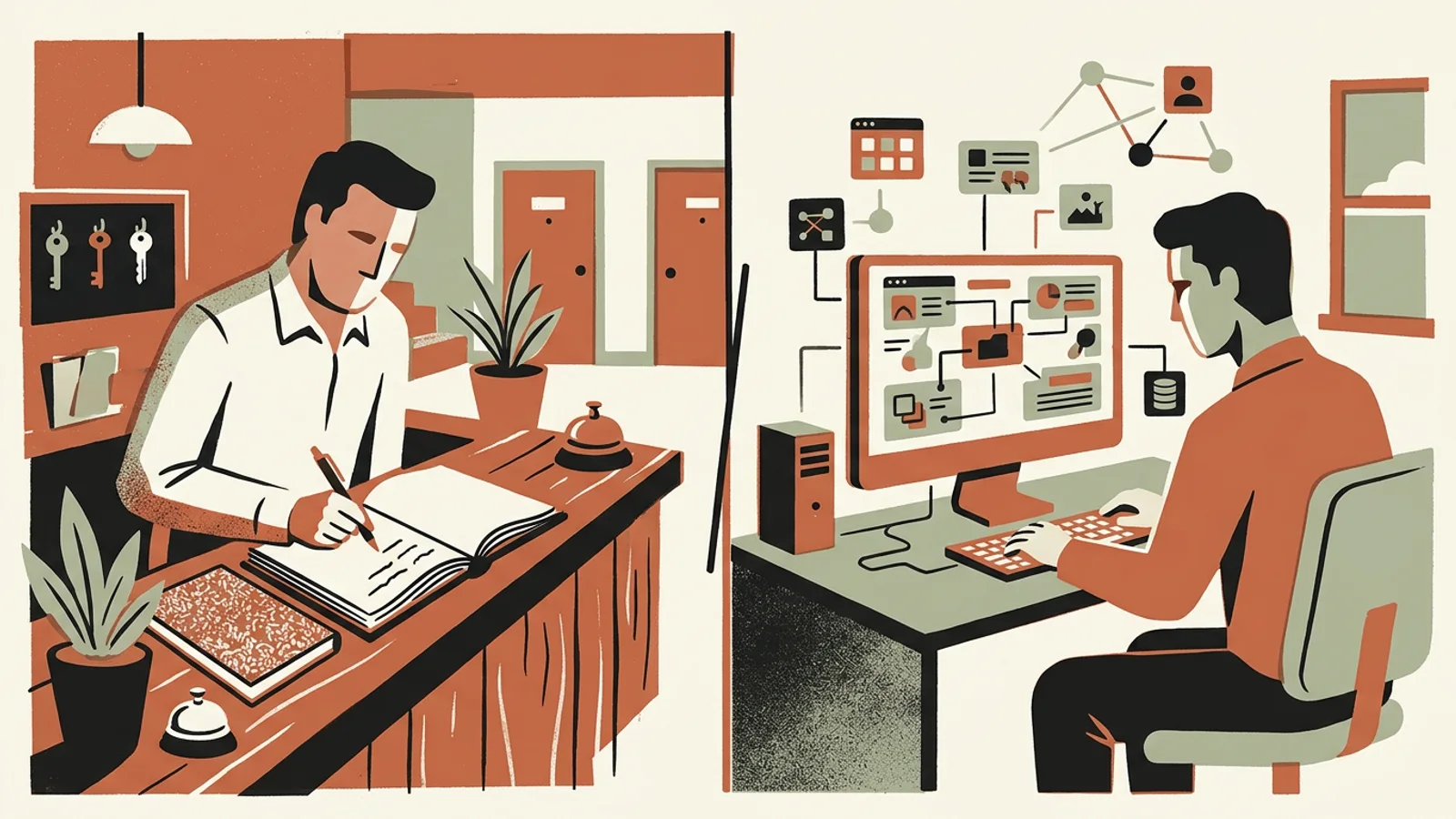
    To make a guest return, you need to know who they were. Most 3-30 room hotels don''t need a paid CRM for that. A paper notebook at reception, or a shared spreadsheet, kept by the receptionist who jots three things after each departure — name, identified stay motive (anniversary, business trip, getaway), one memorable detail (''likes Earl Grey'', ''bathroom too warm in July'') — is more than enough in year one. A paid CRM becomes useful when your base passes 800 active contacts and manual consolidation takes longer than the decision. Before that, the tool isn''t the problem: the discipline of noting is.

    The right time to fill the guest sheet isn''t at arrival — it''s in the ten minutes after departure, while the receptionist still has the conversation in mind. Three lines suffice.

  4. Work the stay anniversary email, not the generic newsletter.

    One year to the day after the stay, the guest receives an email signed with a first name — not a newsletter, not a promo. The email says three things: ''it''s been a year'', ''here''s what''s changed since'' (one concrete detail — the new terrace, the kitchen garden, the revisited breakfast menu), ''we''d love to see you again''. No discount, no promo code in the first email. The discount devalues the relationship and anchors a new price norm in the guest''s head. The specificity of the anniversary email — dated, personal, signed — weighs much more than a reduction. On a 14-room hotel, a well-done anniversary email brings back 12 to 18% of guests in the quarter that follows. Five times better than a general campaign.

  5. Measure loyalty at 18 months, not 30 days.

    A guest returning within 30 days is a business traveller on local assignment, not a loyalty signal — they''d probably have booked with you anyway. The right indicator is the 12-18 month return rate: of 100 distinct guests hosted between January and June last year, how many had a second stay between July and the following June. This indicator takes time to build (you need at least 18 months of data), but it''s the only one that really says whether your hotel settles into people''s lives. Healthy target for an independent boutique: 22-30%. Under 15%, either the experience doesn''t take root, or no recall mechanic exists. Above 35%, you probably have a regional hotel in a niche market — rare and precious. Piloting that indicator belongs to Weekly piloting.

Do / Don't

Do

  • Think hotel loyalty in annual cadence, not monthly — one well-placed email a year beats ten automated newsletters.
  • Keep a simple guest base (paper notebook or spreadsheet) with 3 lines per stay — name, motive, memorable detail.
  • Send a stay anniversary email signed with a first name 12 months later, no discount, with a real piece of news to mention.

Don't

  • Launch an automated monthly newsletter — the guest either unsubscribes or your brand goes transparent to their eyes.
  • Put a promo code in the first follow-up — you devalue the relationship and anchor a new reference price.
  • Confuse loyal guest (returns) and referring guest (talks about you) — both count but aren''t worked the same way.
A concrete case

Situation

Two independent hotels with 10 and 13 rooms in Vendée, 4 km apart, same summer clientele (families with 6-14 year-old children, 4-7 night stays in July-August). Hotel A keeps a paper notebook at reception; B relies on its PMS, nothing more.

Action

At every A departure, the receptionist writes three lines: name, composition (two parents, two children aged 8 and 11), one detail (''the elder made progress on the family bike, they leave thrilled by the coastal path''). In September, the owner sends 84 personal emails — not a newsletter, not a group send. Each email mentions the July note (''we hope Lucas has kept up the cycling this year'') and announces the next spring''s news (extended terrace, new outdoor games). No discount, just an ending line: ''if you want your usual rooms 14 and 15, let me know before end of November and I''ll block them''. B sends an automated quarterly newsletter with off-season promos.

Outcome

Of A''s 84 emails, 27 replies received, 19 bookings confirmed for the following summer between October and December — a 23% year-1 return rate, before booking platforms even open. B gets 4 direct bookings from past guests in the same period. At 18 months, A holds a 31% return rate (a family boutique that settles into the families'' summer ritual), B sits at 9%. The difference doesn''t show in the room — it shows in the reception''s notebook and in the 84 personal emails sent in September.

Common pitfalls

Where it usually goes wrong.

  • Over-soliciting with a quarterly cadence.

    The mistake of hoteliers discovering email marketing: send a newsletter every quarter to ''stay top of mind''. Except hotel loyalty doesn''t work like restaurant loyalty — your guest doesn''t book a weekend every three months, they book a weekend once or twice a year, sometimes less. Four emails a year reminds them you exist when they aren''t thinking about travel. At best they forget you, at worst they unsubscribe. The cadence that weighs is the one matching the moments they actually think about leaving: an email at the stay anniversary, and one at the season matching their initial motive. Two emails a year, sometimes three — no more.

  • Confusing guest file and marketing list.

    A guest file useful for loyalty looks like a notebook of human details — preferences, motives, idiosyncrasies. A marketing list looks like an 800-row Excel sheet with email, gender, postcode. The first lets you write a personal email; the second sends a generic newsletter. Many hoteliers move to the second because it feels more pro, and lose the substance that made the difference. If your file doesn''t contain one memorable detail per guest, it''s no longer a guest file — it''s a prospect file.

  • Believing a points programme works on an indie.

    Points programmes (''10 nights, 1 free'') work for chains — Accor, Marriott — because they rest on 5,000 properties. A guest who sleeps 10 nights in a Mercure will have visited 10 cities. On an independent 12-room hotel in Vendée, the equivalent would ask your guest to return 10 years in a row — mechanically impossible. What works on an indie is memory — the room 14 booked ahead, the favoured Earl Grey, the children''s names. That''s not a programme, it''s attention. And it doesn''t digitalise.

Takeaway

Your checklist.

  • Do you have a stay-anniversary send mechanic at 12 months — not a generic newsletter.
  • Do you keep a 3-line guest sheet after every departure — name, motive, memorable detail.
  • Do you know your 12-18 month return rate — not a 30-day loyalty rate which makes no sense in hotels.
  • Do you distinguish your work on returning guests from your work on referring guests.
  • Are your follow-up emails signed with a first name, or do they carry a generic ''The X Hotel team'' signature.
  • Did you resist the urge of the promo code in the first anniversary email — proof you keep the relationship above the price.
What's next?

Method in hand. Time to put it to work.

A method is set — still, you need time to put it to work. Readytopost frees that time by taking one front off your plate: your presence on the five social networks. Everything written, illustrated, scheduled — calibrated on your hotel, week after week. So your energy stays on the trade.

Start with ReadyToPost

See how these principles play out day to day. Practice for independent hotels gives you concrete, illustrated, adaptable levers — directly applicable the following week. No quarterly plans, no annual roadmaps: weekly gestures that touch something right away.

See it in practice
hotel

Other guides for independent hotels

Weekly piloting for indie hotels

Four Monday indicators: piloting a boutique property

Four indicators read every Monday are enough to pilot an independent hotel. Not ten, not twenty: four — pickup J+7 vs J+30, ADR vs local market, direct/OTA channel mix, review sentiment last 7 days. Each triggers a clear decision at every reading. The rest is dashboard that reassures without changing anything. And it all fits in a shared spreadsheet — no €400/month revenue manager required.

Arrival weighs 80% of the stay

Arrival matters: the moment of truth in a small hotel

A guest decides their Booking score within the first twenty minutes: the pre-stay email they received, the smile at the front desk, the first five seconds in the room, the bathroom smell. The rest of the stay confirms or nuances — it no longer overturns. Everything that plays out before and at arrival weighs more than pillow quality or balcony view.

Pick a guest type to serve

Picking the guest type you serve: the pivot decision

With 20 keys, chasing the weekend couple and the Tuesday business traveller at once means serving both badly. Naming one or two guest moments — short weekend, mid-week business, family long-stay, 7+ night digital nomad — is the call that aligns the breakfast offer, the front-desk tone and the rate quoted direct.

Push direct bookings

Push direct bookings: 5 moves over 7 days

OTA at 63% of mix, 18% commission: each point gained in direct is worth 14% more net revenue. Five moves placed over 7-14 days to push direct booking without destroying room value.

Further reading

Related blog articles

  • case-studies

    A boutique hotel reclaims its margins

    No pro shoots. No agency. Just iPhone photos taken between two services, processed differently. Six months later, the numbers shift.

  • social-media-strategy

    Google is ending its search bar.

    Google rebuilt the search bar as an AI agent. The click on the top organic result already dropped 58 percent. For an independent, the marketing minutes shift from SEO long-tail to social presence, the field where your name still gets remembered.

  • case-studies

    The product photo threshold

    A product photo on a plain background gets catalog reach. The same product photographed in context gets saved. Here is where that line sits.

  • content-creation

    When the image says one thing

    The most common failure in a social post is not the caption. It is the gap between what the image shows and what the text claims.

Questions

Frequently asked.

  • Why is a returning guest worth five times a new one?

    Three factors stack. First they cost nothing to acquire — no OTA commission (18% average on an independent boutique), no acquisition campaign. Second they cancel far less — OTA cancellation runs around 21.8% versus 10.6% direct, and even lower for a returning guest. Third they consume better — more frequent breakfast, more regular dinner on-site, longer stays on average. Combined, these three variables give a unit margin 4 to 6 times higher than a new guest captured via Booking. On the 2026 market, that''s almost the main hidden RevPAR reserve for an independent hotel.

  • How often should you write to a past guest?

    Twice a year maximum. An email at the stay anniversary (12 months to the day, signed with a first name, no discount), and possibly one at the season matching the initial motive (a couple who came in September for an anniversary = email in June the following year). Beyond that, you enter promo-newsletter territory, which ends in the spam filter or in unsubscriptions. Hotel loyalty is built on contact scarcity, not frequency — the inverse of e-commerce logic.

  • Should you offer a discount to bring a guest back?

    Not in the first email. A discount in the anniversary email tells the guest two things: that they were worth their price last year but you''re unsure today, and that you need to fill rooms. Both devalue the relationship. What weighs is specific attention — a detail recalled from the previous stay, a concrete piece of news, the offer to block THE room they liked. If a promo must exist, it comes in the second exchange, after a guest reply, and always on a non-transactional pretext (a night offered for a 4-night stay, rather than -15% per night).

  • What''s a good return rate for an independent hotel?

    The 12-18 month return rate is the most reliable indicator. For a 3-30 room independent boutique, a healthy range sits between 22 and 30%. Under 15%, either the experience doesn''t take root (the room is decent but unsignatured), or no recall mechanic exists — almost always the second cause. Above 35%, you probably have a regional hotel in a niche market (spa, thermal town, specific coastal escape), rare and precious. The French independent average sits around 18% — meaning 82% of guests never return, the largest invisible margin leak in the sector.

  • Do you need a paid CRM to make guests return?

    Not while your base stays under 800 active contacts. A paper notebook at reception, or a shared Google Sheet, is plenty for the first 12-18 months. The challenge isn''t the tool — it''s the discipline of writing three lines per guest after departure, and holding the anniversary send every year. The CRM becomes useful when manual consolidation takes longer than the decision, and when you want to segment (couples weekend vs summer families). But the classic mistake is buying HubSpot or Mews CRM hoping it''ll do loyalty for you — it organises, it doesn''t create. Human discipline always comes first.