




r.
Diagnosis · Decode margins

Protecting margins without sounding like a sales pitch

The setup

Margin never drops all at once. It erodes line by line, category by category — and it's that erosion you have to learn to read, month after month, before touching a single price or supplier.

Symptoms

You might recognise these signs.

  • Revenue roughly holds, but gross margin drops 2 to 4 points over a few months — with no single line explaining it all.
  • The food cost ratio goes from 28-30% to 33-35%, even though the menu hasn't changed and volumes are stable.
  • Payroll nibbles a little more each month, with no extra hires — overtime and cover shifts pile up silently.
  • Certain dishes sell heavily, but their real food cost (including waste and garnishes) tops 40% — you sense it without being able to pin it down.
  • Month-end inventories show unexplained gaps between theoretical and physical stock, especially on liquids and fresh products.
Method

Step by step.

  1. Read the two ratios that eat everything.

    Food cost and labour cost together account for 60 to 72% of revenue in a restaurant that holds up. Beyond that, margin inevitably leaks. But the diagnosis doesn't start with the total — it starts with knowing which of the two moved. A food-cost drift and a labour drift tell different stories, and the lever isn't in the same kitchen. Pull twelve rolling months and plot the two curves separately, month by month.

    If both ratios rise at the same time, look at volumes: it's often a mechanical effect of fewer covers, not a structural drift. As shown in Read the room, a dip in footfall hits the labour ratio first — the team stays, revenue falls.

  2. Break margin down by category.

    Overall margin is a misleading aggregate. Starters, mains, desserts, drinks — each has its own margin, and it's rarely the same block that carries profitability. On most menus, drinks (wines, soft drinks, coffee) hold a disproportionate share of the real margin. When the overall margin slips, first check which of the four categories is dropping. A margin drop on drinks and a margin drop on mains aren't diagnosed the same way.

  3. Pull the top 10 margin destroyers.

    Cross-reference for each dish: real food cost, selling price, volume sold. The margin-destroying dish is almost never the one instinct points to. Often it's a dish at 40% food cost that sells huge volumes — its volume amplifies a poor unit margin. Sometimes it's a dish with a beautiful unit margin that simply doesn't sell — it takes up a menu line without contributing anything. The raw table, with no interpretation, reveals both profiles.

    When a popular dish concentrates the margin destruction, also look at how much of its sales go through delivery platforms — the commission eats further into unit margin, and the diagnosis moves closer to Measure the platforms than to a menu question.

  4. Measure waste and returns.

    Waste is margin already paid for, heading straight to the bin. Weigh or count it over two weeks: what comes back from the dining room (unfinished plates), what gets tossed during prep, what expires in stock. Three to five percent of revenue often goes out this way without ever being logged. The diagnosis doesn't call for an industrial setup — just two weeks of quiet counting to know whether the leak is here or somewhere else.

    If plate returns always involve the same dish, it isn't a waste question — it's a signal about portion, cooking or how the dish is composed. Treat it as a menu signal, not a cost signal.

  5. Compare to your own period, not the sector.

    Sector benchmarks ("30% food cost in a bistro") hide enormous variance between venues. The right reference is you, twelve months back, on the same calendar month. If your food cost ratio was at 29% last March and it's at 33% this March, the 4-point gap is something you can act on. If you compare against a benchmark, you reassure or alarm yourself without learning anything about your own drift.

Do / Don't

Do

  • Plot food cost and labour cost over a rolling twelve months, separately, month by month.
  • Break margin down by category (starters, mains, desserts, drinks) before touching any price.
  • Compare each month to your own month a year earlier, not to a sector benchmark.

Don't

  • Renegotiate a supplier on reflex when the food cost ratio rises — you won't know whether the lever was actually there.
  • Read the overall margin as a signal — it's an aggregate, the diagnosis lives in the breakdown.
  • Bump every price on the menu up a notch before identifying the 3 to 5 dishes that are genuinely destroying margin.
A concrete case

Situation

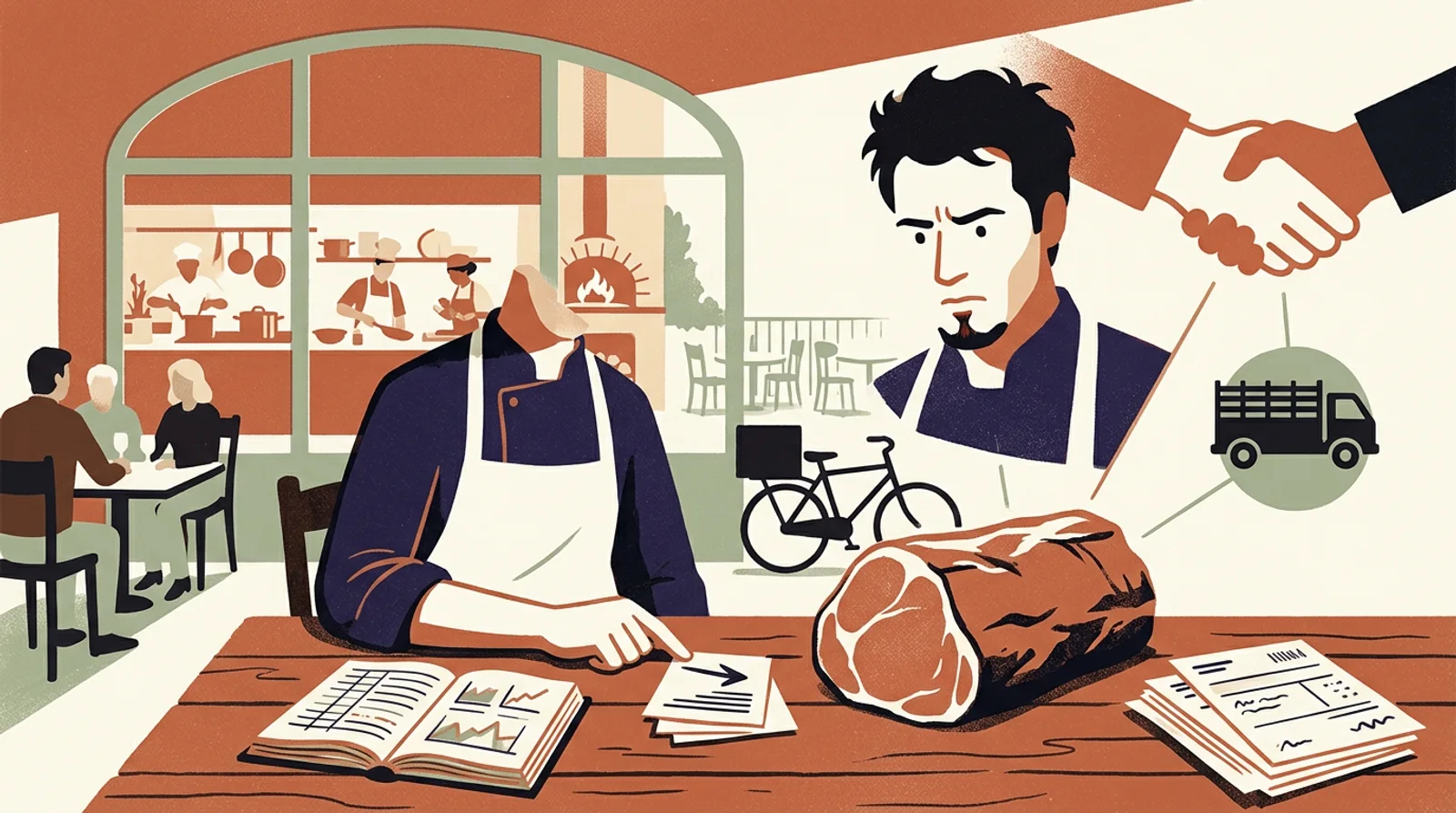
A bistronomy restaurant notices its gross margin down 3 points over six months. The owner's first instinct: renegotiate the meat supplier, the line that weighs most in absolute value.

Action

Before picking up the phone, he breaks it down. The food cost ratio moved from 30% to 31%, marginally. The labour ratio, though, went from 36% to 39% — three points in six months, with no new hires. He cross-checks against the schedules: evening-service overtime has doubled to cover the turnover of two front-of-house roles. The leak wasn't in purchasing, it was in the stability of the team — something to dig into via Track the team.

Outcome

The diagnosis wasn't a food cost problem but a payroll figure quietly drifting. A supplier renegotiation would have clawed back 0.5 points of margin — the real cause was worth six times that. The menu didn't change, neither did the prices. The real lever sat outside the purchasing side of the P&L.

Common pitfalls

Where it usually goes wrong.

  • Mistaking a food-cost drift for a volume drift.

    When covers drop and fixed costs stay, the food cost ratio rises mechanically even if nothing changed on the purchasing side. Reading a ratio as a percentage without looking at absolute volume means mistaking a footfall problem for a food cost problem. Two opposite diagnoses, two opposite levers.

  • Reading a single month as a trend.

    One month of degraded food cost after a miscounted inventory, or a week of heavy spoilage on a fresh product, gives you a data point that looks alarming. A trend is three consecutive months minimum, compared to the same period a year earlier. Rushing to diagnose leads to structural decisions built on simple accounting noise.

  • Renegotiating the main supplier on reflex.

    The supplier that weighs most in absolute value isn't necessarily the one whose margin is leaking. Many leaks hide in the small lines — dry goods, wines by the glass, coffee, garnishes — where nobody looks because the amounts seem negligible individually. Added up over the year, they often weigh more than a point negotiated on the main line.

Takeaway

Your checklist.

  • This month's food cost ratio vs. the same month a year earlier.
  • This month's labour ratio vs. the same month a year earlier.
  • Margin by category (starters, mains, desserts, drinks) — which one moved.
  • Top 10 dishes by volume x food cost — which destroys, which carries.
  • Waste weighed or counted over two weeks (prep + returns + expired).
  • Theoretical vs. physical inventory gap, especially on liquids and fresh products.
What's next?

Diagnosis made. Now act on it.

You've just identified where it's breaking. Addressing it will take your time, your focus, your energy. Meanwhile, your communication can't go dark — or turn into filler. Readytopost keeps it at a demanding level on the five social networks: posts written, images generated, calendar filled — calibrated on your work.

Start with ReadyToPost

Keep going on your own. The method for restaurants lays out the principles that turn a diagnosis into durable action — across every lever, not just communication. Concrete markers to help you decide on the fly, without imposed recipes or rigid calendars. At your pace, at your scale.

Continue to the method
Questions

Frequently asked.

  • What food cost ratio is healthy for a restaurant?

    There is no universal number. A bistro runs around 28-32%, a fine-dining spot can climb to 35-38% with premium ingredients, a fast-casual sits at 25-28%. More useful than any benchmark: your own ratio over a rolling twelve months, month by month. A drift of 2 to 4 points against your own history is a signal worth acting on. The reference isn't your sector, it's you.

  • Why are my margins slipping even though revenue holds steady?

    Three readings to make before drawing any conclusion. Either the food cost ratio has crept up (supplier inflation not passed on, portion drift, rising waste). Or the labour ratio has climbed (overtime, cover shifts, invisible turnover). Or your margin by category has shifted — you're selling the same volume, but the product mix has tilted toward lower-margin dishes. A stable overall margin often hides a mix that's quietly drifting.

  • How do I tell whether my food costs are leaking or whether the menu is the problem?

    The distinction shows up when you cross two readings. If the food cost ratio rises on dishes whose theoretical food cost is stable, the leak is operational (waste, portions, theft, faulty inventories). If it rises because high-food-cost dishes are taking a growing share of sales, it's the menu mix that's drifting — typically when a popular but barely profitable dish soaks up sales at the expense of higher-margin plates.

  • How often should I review my prices?

    The diagnosis doesn't tell you how often to act, it tells you how often to read. Reviewing prices belongs to method, not diagnosis. On the reading side: a monthly check on your ratios and a quarterly check on margin per dish are enough to catch a drift before it settles in. Reacting to every monthly figure is overreacting. Ignoring it for a year is letting the leak take root.

  • Should I squeeze a supplier when margins drop?

    Before renegotiating anything, lay out the breakdown. If the drift comes from the labour ratio, the product mix or waste, squeezing a supplier doesn't touch the cause. And even if the leak really is in food cost, your biggest supplier by absolute value isn't always the one whose costs have drifted the most. The small lines (dry goods, wines, coffee, garnishes) often carry most of the gap, with nobody ever looking at them.

restaurant

Other guides for restaurants

Working your Google reviews

Working Google reviews: the loop that lifts

Google reviews don't just arrive — they're worked. Five concrete moves to place this week that turn a passive listing into a system of asking, answering and adjusting.

Running a short campaign

Running a short campaign without breaking margin

A tasting, a partnership with the wine shop next door, a one-off dish on a Thursday night: a short campaign can restart momentum — or devalue the rest of the menu and chip away at the margin without leaving anything behind. Five concrete moves to design it, frame it financially, and track it from Monday to Sunday.

Winning back a regular

Win back a regular: 5 concrete moves

A regular who used to come every week and now shows up every two months won't be won back by a marketing email or a discount. Five moves to place this week — named, written, measurable — to crack the door open without forcing it.

Rescue a slow service

Rescue a slow service: 5 concrete moves

A specific service that's dragging — Tuesday night, Sunday lunch — doesn't need a full overhaul. Five moves placed this week are enough to shift the line the following week, without touching the menu or the prices.

Further reading

Related blog articles

  • content-creation

    How long should a caption be?

    Length is the wrong question. A feed folds your caption at a fixed line, and only what sits above it gets read. Here is where that line falls — and what belongs above it.

  • social-media-strategy

    Organic vs Paid Social for a Small Business

    Paid social rents reach; only organic can turn it into an audience you keep. For a small business the order matters more than the split — and a dead profile sinks both.

  • content-creation

    Best time to post: does it matter?

    The best-time-to-post charts were built on millions of huge accounts. For an independent with a few hundred followers, the clock is a rounding error. Here is what moves reach instead.

  • case-studies

    Should a small business try to go viral?

    Everyone wants the post that explodes. For a local independent, a viral spike is the wrong target. It inflates reach, not the audience that books you. Here is what to aim for instead.

Social networks

Network by network

LinkedIn Post Generator

AI LinkedIn Post Generator & Scheduling

Generate professional LinkedIn posts, mention real people and companies right in the text, then publish to your profile or your company page.

Facebook post generator

AI Facebook Post Generator and Scheduling

Generate conversational Facebook posts, set your emoji and hashtag level, and schedule them straight to your Facebook Page. Text and visual built for the feed.

Instagram Post Generator

AI Instagram Post Generator

Generate on-brand Instagram posts where the 4:5 feed visual and the caption are built together — a scroll-stopping hook, breathable paragraphs, and full-word hashtags grouped at the end, scheduled and ready to publish.

Resources

Guides by profession

Makers

Your hands shape the object; the image is what sparks the wanting. People reach for it because they first fell for the way it looked.

12 resources

coach

No product to shoot, no storefront: just your expertise to make visible — enough for a prospect to book a call.

12 resources

hotel

Twenty keys don't run like a chain. Occupancy, RevPAR, traveller, front desk: the calls no one will make for you.

12 resources