
Working Google reviews: the loop that lifts
Google reviews don't just arrive — they're worked. Five concrete moves to place this week that turn a passive listing into a system of asking, answering and adjusting.
A campaign that doesn't hold its margin on day one won't catch up on day seven.
A short campaign isn''t a discount and it isn''t a permanent event. It''s a window — a few days, one single angle, a measurable mechanic — that has to create intensity without devaluing the rest of the menu or hollowing out the room the week after. The difference between one that pays and one that costs gets settled before the first service.
A single day doesn''t create word of mouth — the guest who talked about it Tuesday night has nothing to offer their colleague Wednesday morning. Three weeks, on the flip side, turns the campaign into routine: it loses its exceptional edge and just shifts demand instead of creating it. The useful window is five to ten days, ideally seven — long enough for a guest to book after hearing about it, short enough to stay an event. Announce the end date on day one of communication, that''s what triggers the booking.
Avoid campaigns that straddle two weekends. The feel becomes ''oh, it''s still on this weekend'', and urgency disappears. Ideal: Tuesday to Sunday, or Thursday to the following Wednesday.
A campaign that says ''-20% on everything this week'' destroys two things at once: the margin, and the perceived value of the menu in the weeks after. The guest who comes back the next month wonders why they''re paying full price today. The form that holds: a one-off dish, an event menu, a partnership (wine shop, brewer, producer), a themed tasting — something that only exists during the campaign and disappears afterwards. The average ticket can be the same or higher than the regular menu; what changes is the angle, not the price. This logic ties into the Decode margins diagnostic: value perception isn''t built with a discount.
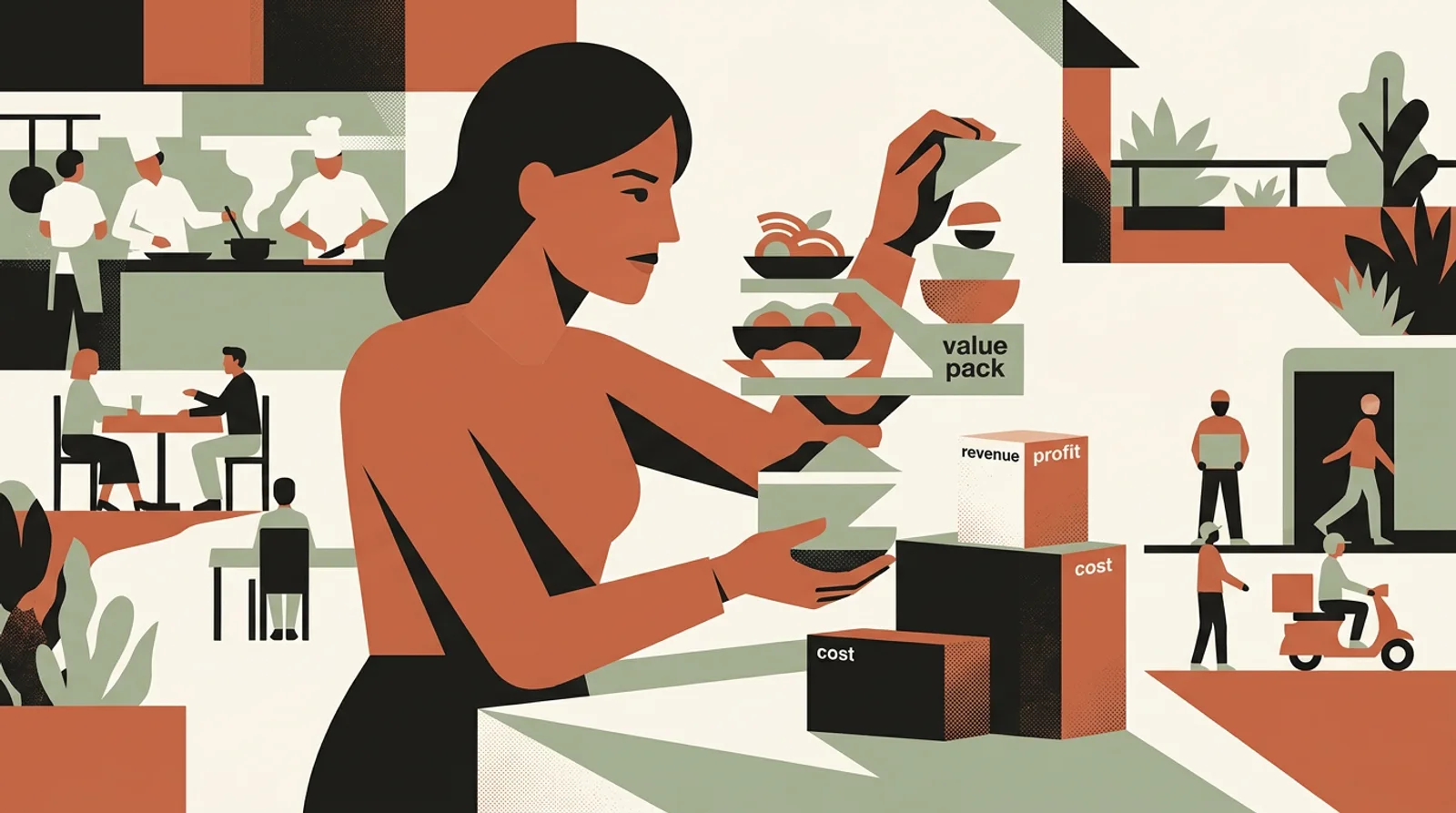
Put three lines on a sheet. Food cost of the dish or special menu (ingredients plus drink portion if included). Expected average ticket on the campaign. Number of incremental covers targeted over the seven days — not the total, the incremental against a normal week. The gross margin per incremental cover has to stay above 30% of your usual gross margin, otherwise the campaign costs more than it brings in. Numbers example: if your average gross margin is £22 per cover, an event menu at £18 of gross margin still holds; at £12, you''re working to cover fixed costs, not to make money. The incremental cover only counts if it''s additive — not if it''s replacing a full-menu cover.
A short campaign benefits from being visible everywhere at once — Instagram, Facebook, LinkedIn, Pinterest, X — with the message tailored per format: a photo that speaks for itself, a short line with the date, longer context where the platform allows. Repeat the same triptych on your Google listing (cover photo changed on day one, Google Business post), in the window, and on a sticker on the bill. The trap isn't spreading wide — it's copy-pasting the same post across five networks. Piloting these channels falls under the Piloting method.
Launch communication exactly seven days before day one — no earlier. Beyond that, the message gets forgotten; under that, weekend diaries are already locked. The 7-to-3 day window is when bookings flip.
Two indicators are enough: incremental covers versus the same week last year, and average ticket on the campaign versus your usual average. Put them on a shared board with the floor team, updated at close. Two kill signals before the end: if after three services the incremental covers sit below 50% of the target, the campaign isn''t lifting — redirect comms or simplify the mechanic. If average ticket drops more than 15% versus your usual average, the offer is cannibalising the menu — cut it now, don''t let the mechanism chew seven days of margin.
Do
Don't
Situation
A neighbourhood bistro wants to relaunch end-of-week trade after two slow months. First reflex: launch a 'Thursday to Friday, -15% on every dish' over three weeks, pushed across all five networks and the newsletter.
Action
Reframed: a 7-day partnership with the wine shop next door around a winemaker''s menu at £38 (starter + main + paired glass). Pre-launch math: food cost £11.50, gross margin per cover £26.50 — 21% above the regular Thursday-Friday à la carte margin. Pushed across the five networks with the same story tailored per format, one photo of the wine shop''s bottle, one line, end date stated. Google listing updated on the morning of day one. The floor team learns about the campaign a week ahead to lock down setup.
Outcome
Over the 7 days, 38 incremental covers versus the same week last year, average ticket at £41 (vs £36 usually — guests ordered a second glass from the wine shop). Total incremental gross margin on the campaign: £1,007, versus a modelled loss of £580 on the -15% scenario. The wine shop saw three of the guests come through their door the week after. The campaign is noted to be replayed next quarter with a different partner — not extended immediately.
When a campaign works, the temptation is to extend it a week, then another, until it becomes a fixed offer. At that point, two things happen at once: guests stop coming ''because it''s exceptional'' (it isn''t anymore), and the special menu starts cannibalising the carte. Hold the announced end date, even if it''s working hard — especially if it''s working hard. Scarcity is what brings people back next time.
More than ten days out, the message gets forgotten by the time people would book. Less than three days out, weekend diaries are already set. The useful window is 7 to 3 days before day one of the campaign — that''s when bookings flip. If you miss the window, it''s better to push the campaign by a week than to launch it into a blind zone.
A campaign learned 48h before launch produces sloppy service for the first two days — kitchen coordination, table suggestions, handling guest questions. Three days later, service is dialled in but the campaign is already half over. The useful rule: full floor briefing at least 5 days before day one, with the menu, the angle, a two-sentence pitch, and clear lines on ''how long does it run''. A well-prepped campaign sells itself at the table.
Pulling these levers every week is already a discipline. Adding communication on five social networks is another — and the one that gets sacrificed first. Readytopost takes the second one off your plate: posts, images, scheduling, calibrated on your restaurant. So the first one keeps all your attention.
Start with ReadyToPostBack to the overview for restaurants to browse all guides — diagnosis, method, practice — in whichever order fits. Three floors that complement each other: one to understand, one to think, one to act. You go in where it pinches most today, and come back when a new question shows up. No required order.
Back to the overviewGoogle reviews don't just arrive — they're worked. Five concrete moves to place this week that turn a passive listing into a system of asking, answering and adjusting.
A regular who used to come every week and now shows up every two months won't be won back by a marketing email or a discount. Five moves to place this week — named, written, measurable — to crack the door open without forcing it.
A specific service that's dragging — Tuesday night, Sunday lunch — doesn't need a full overhaul. Five moves placed this week are enough to shift the line the following week, without touching the menu or the prices.
Loyalty isn't a stack of nice gestures — it's a system. Five principles to think about return visits by the quarter, not by the week, and stop mistaking a punch card for actual loyalty.
platform-guides
Five platforms publish changelogs that document what each algorithm rewards. Almost nobody reads them. Here's what two years of release notes reveal.
platform-guides
Asphalte invites its audience to co-create the next collection — in public, on the same feed where it posts launches. The mechanism is documented and transposable. Here is how.
case-studies
Better work, fewer clients. Here is the case of an interior designer who solved the wrong problem first — and what she did differently the second time.
social-media-strategy
The jargon circulates. Here is what it means when you are the only person running your brand online.
Five to ten days, ideally seven. A single day doesn''t create word of mouth — the guest who heard about it Tuesday night has nothing to offer Wednesday. Three weeks turns the campaign into routine and strips its exceptional feel. The useful window is the one where a guest can hear about the campaign, talk about it, and have time to book — without the event settling into the daily noise. Also avoid it straddling two weekends, which dilutes urgency and pushes decisions back.
A special offer, almost always. A discount (''-15% on the menu this week'') destroys margin during the campaign and value perception in the months after — the guest who pays full price later wonders why. An additive offer (an event menu, a one-off dish, a partnership with a local producer or artisan) only exists during the campaign and disappears afterwards. Average ticket can be the same or higher; what changes is the angle, not the price. It also keeps you from training your guests to wait for the next discount.
Three numbers are enough. Food cost of the dish or special menu (ingredients plus drinks portion if included). Expected average ticket on the campaign. Number of incremental covers targeted over the duration — the ones that add to your normal traffic, not the total. The gross margin per incremental cover has to stay above 30% of your usual gross margin. Below that, the campaign absorbs fixed costs without leaving anything behind. Key rule: an incremental cover that replaces a full-menu cover isn''t a gain, it''s a substitution — it doesn''t count in the math.
Across all your channels at once — Instagram, Facebook, LinkedIn, Pinterest, X — with the message tailored per platform. Photo and context on Instagram and Facebook, the chef's voice on LinkedIn, the visual archived on Pinterest, a short relay on X. Repeat the same story on your Google listing (cover photo changed on day one, Google Business post), in the window, and on a sticker on the bill. The mistake isn't reaching everywhere — it's copy-pasting the same post on every channel. The campaign gains visibility when each format finds its natural angle.
Two clear signals justify an early stop. First: after three services, incremental covers versus the same week last year sit below 50% of the target you set. The campaign isn''t lifting, and pushing through seven days like that burns energy without return — redirect comms or simplify. Second: average ticket on the campaign drops more than 15% versus your usual. The offer is cannibalising the menu instead of amplifying it — cutting it avoids chewing margin on the remaining days. Outside those two signals, hold until the announced end date, that''s what creates scarcity for next time.