

Working Google reviews: the loop that lifts
Google reviews don't just arrive — they're worked. Five concrete moves to place this week that turn a passive listing into a system of asking, answering and adjusting.
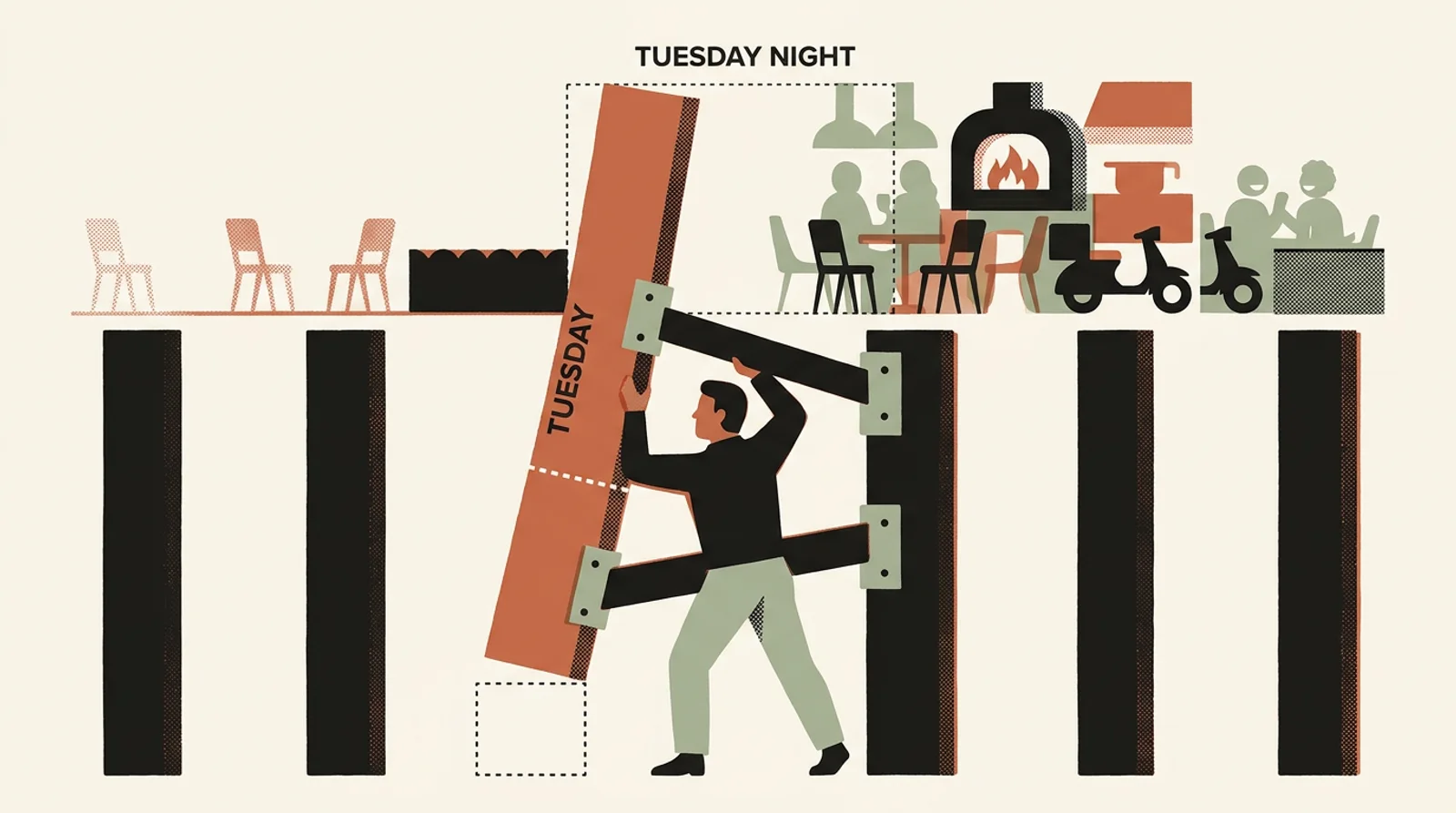
You don't rescue a service by rewriting the menu. You rescue it by putting a reason to come back on that slot.
A restaurant doesn''t improve in one big move — it improves through fifty small moves placed where they touch something. No fireworks, no transformation: an arithmetic of small lines that add up over twelve months, then the next twelve. Practice gives you those moves, one at a time — each one applicable this week, readable the next.
Before you place a single move, you name the service you''re rescuing precisely: one day, one time window. ''Tuesday night, from 8:30pm.'' Not ''weekday evenings.'' The point is to have a concrete target for the rest of the week. Count the covers served on that exact slot over the last eight weeks, compare against the eight weeks before that on comparable conditions (the deeper read sits in Read the room). If the gap holds, you''ve got your target.
As long as you''re working ''evenings'' in the broad sense, no move will be sharp enough to shift a line. The right grain is one day plus a two-hour window.
Not a campaign. Not a mass mailing. You take 20 to 30 numbers of regulars who used to come on that exact service six months ago and haven''t been back since. You write yourself, from your own phone, a short message — not an obvious copy-paste: ''Hi Sophie, we haven''t seen you on a Tuesday night in a while. There''s a dish I''d love you to try this week if you swing by. Talk soon — Mark.'' Tailored to each person in 30 seconds. Out of 25 messages, expect 5-7 replies and 2-4 walk-ins over the week. The thinking behind this move is framed in Make them return.
If you don''t have those numbers, that''s the first brick to lay — a paper notebook is enough to start. You don''t need a CRM this week.
On your Google Business profile, publish a post (use ''Update'' or ''Offer'') that only talks about that exact slot. A recent photo — less than two weeks old — of the dish or of the room shot at that hour. A simple headline: ''Tuesday night, 8:30pm: this week''s dish.'' Three lines of description, no superlatives. A concrete mention of the reason to come (see step 4). It''s free, it''s indexed within hours, and it''s what someone searching your name or ''restaurant open Tuesday night [your neighbourhood]'' will see over the next few days.
Google Business posts expire after 7 days for Updates, 30 for Offers. Line your publish date up with the slot, not three days out.
Not a discount — a discount eats into your margin and doesn''t bring people back at full price. You put a one-off reason that adds value without devaluing: a glass on the house for early seating (before 8:30pm, to help spread the room), a specific daily special announced only for that service, a house dessert reserved for guests on that slot. The point is to give an answer to ''why Tuesday night instead of Friday''. The cost is marginal (£1-3 per cover), the perception effect is far bigger than a 10% discount on the bill.
A free identifiable item (a glass, a dessert) hits the imagination ten times harder than a percentage off. For the same real value.
At the weekend''s close, you count three numbers for that slot: covers served this week vs the week before, SMS reply rate, and the number of guests who mentioned the Google post or the reason to come. If the slot moved by +3 or +4 covers, you''re holding something — you run the same sequence the following week with a different reason to come. If nothing moved, the lever isn''t in this week''s tactic: you need to dig upstream (review reading, neighbourhood read). You don''t grind for three weeks on a move that gave no signal after two.
Do
Don't
Situation
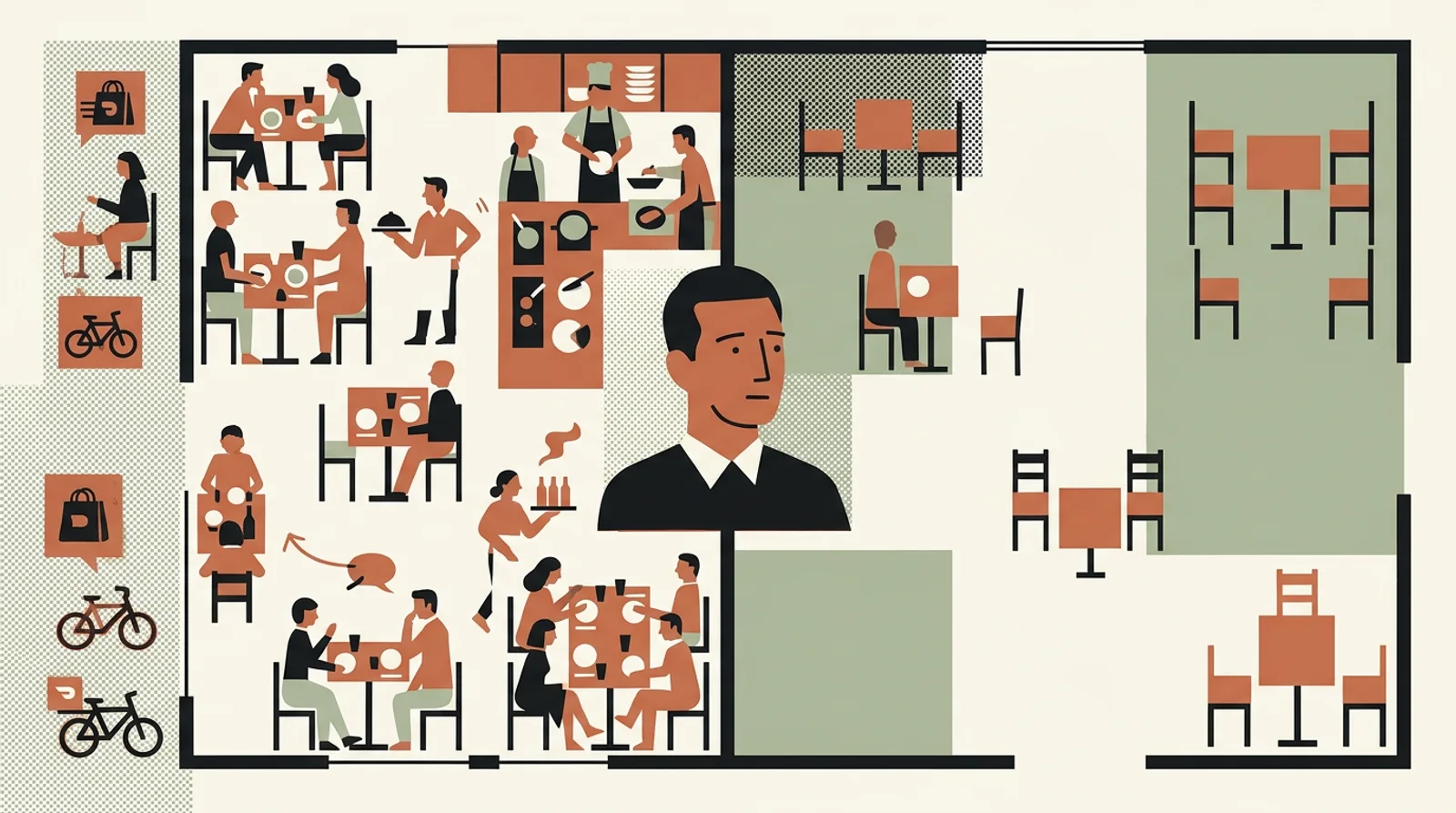
A neighbourhood bistro fills Thursday through Saturday but collapses Tuesday night: 14 covers on average versus 38 on Thursday, same room capacity.
Action
The owner targets Tuesday 8:30-10:30pm precisely. Monday night, she sends 28 personal SMS to Tuesday regulars she hasn''t seen in two to four months. Tuesday morning, she publishes a Google Business post on her profile: photo of the week''s dish taken the night before, caption ''Tuesday night: our seasonal dish, and a glass on the house before 8:30pm''. The Tuesday daily special is announced only on that service, not the rest of the week.
Outcome
The following Tuesday: 23 covers instead of 14. Out of the 28 SMS, 9 replies and 4 walk-ins. The Google post drove 11 extra profile views between Monday and Tuesday night. The week after, the same sequence with a free dessert instead of the glass brought in 21 covers. Third week, the owner skips the SMS (list tapped out by that point) and keeps the Google post plus the dedicated dish: 19 covers. Three weeks, +5 to +9 covers on average, without touching the menu or the base price.
A 15% discount on the bill costs as much as a glass on the house and gets people talking far less. Worse: it anchors in the customer''s head as the new normal price, and going back to full price two weeks later feels like a raise. A reason to come has to add something, not take off price. That distinction is framed more broadly in Make them return.
If three services are dragging — Tuesday night, Sunday lunch, Wednesday lunch — the temptation is to hit them all the same week. It''s almost always a tactical mistake: it dilutes the SMS, dilutes the posts, dilutes the reasons to come. Rescue one service, then the next, then the next — three weeks of targeted moves — almost always pulls more covers than an ''all services'' push run in one block.
Personal SMS and Google posts have a reply cycle spread over 7 to 14 days. Some recipients read it, can''t make it this week, and come the next or the one after. Measuring success on seven days is too short. The useful rule: run the sequence two weeks in a row (with a variation on the reason to come), then decide. Before two complete cycles, you can''t tell whether the lever holds.
Pulling these levers every week is already a discipline. Adding communication on five social networks is another — and the one that gets sacrificed first. Readytopost takes the second one off your plate: posts, images, scheduling, calibrated on your restaurant. So the first one keeps all your attention.
Start with ReadyToPostBack to the overview for restaurants to browse all guides — diagnosis, method, practice — in whichever order fits. Three floors that complement each other: one to understand, one to think, one to act. You go in where it pinches most today, and come back when a new question shows up. No required order.
Back to the overviewGoogle reviews don't just arrive — they're worked. Five concrete moves to place this week that turn a passive listing into a system of asking, answering and adjusting.
A tasting, a partnership with the wine shop next door, a one-off dish on a Thursday night: a short campaign can restart momentum — or devalue the rest of the menu and chip away at the margin without leaving anything behind. Five concrete moves to design it, frame it financially, and track it from Monday to Sunday.
A regular who used to come every week and now shows up every two months won't be won back by a marketing email or a discount. Five moves to place this week — named, written, measurable — to crack the door open without forcing it.
Loyalty isn't a stack of nice gestures — it's a system. Five principles to think about return visits by the quarter, not by the week, and stop mistaking a punch card for actual loyalty.
platform-guides
Five platforms publish changelogs that document what each algorithm rewards. Almost nobody reads them. Here's what two years of release notes reveal.
platform-guides
Asphalte invites its audience to co-create the next collection — in public, on the same feed where it posts launches. The mechanism is documented and transposable. Here is how.
case-studies
Better work, fewer clients. Here is the case of an interior designer who solved the wrong problem first — and what she did differently the second time.
social-media-strategy
The jargon circulates. Here is what it means when you are the only person running your brand online.
The order of magnitude observed in independent restaurants is +3 to +9 covers on a service that was running between 10 and 20. On a busier service (35-50 covers), the relative gap will be smaller — there''s less slack. If you see no movement after two complete cycles (two weeks), the problem isn''t tactical: you need to widen the read beyond the slot itself. Either the kitchen or the front of house on that service has drifted, or the neighbourhood has shifted, or the Google profile has a deeper issue (old photos, recent negative reviews).
If the recipient is a known guest of the house and the message is obviously hand-written — first name, human tone, clear signature — the response is almost always positive. What bothers people isn''t the SMS, it''s the generic SMS spottable in two seconds (''Dear customer, enjoy our special offer...''). A short message, signed, mentioning something specific (''we haven''t seen you on a Tuesday night in a while'') reads as attention, not advertising. Out of 25 sends, expect zero complaints and 5 to 9 replies.
Yes, and in concrete terms. The team needs to know +5 to +10 covers are expected that night, that a dish or glass is part of the reason to come, and who the guests to recognise are if they reply to the SMS. Without that alignment, the operation creates noise on service without capitalising on the attention you''ve built. Five minutes at pre-service briefing on Tuesday is enough: targeted slot, expected reply count, gesture to make (''Sophie confirmed, she''s coming at 8:45pm with her husband'').
The logic holds, but the mechanics shift. Personal SMS works less well for weekday lunch (active regulars don''t read personal SMS between 9am and noon). Lean instead on a Google Business post framed around the daily set menu, published the night before; a story on the house''s Instagram the morning of; and a real signage push at the door (chalkboard, mention of the slot). The reason to come is better served by a specific daily special announced the day before — lunches get decided D-1 or that morning, not a week out.
Same structure (SMS + post + reason to come), but vary the content. The week 1 SMS recipients aren''t the same as week 2 — you work a rotating list to avoid wear. The reason to come changes too: glass on the house week 1, signature dish week 2, free dessert week 3. The structure holds, the content rotates. After three or four weeks, you''ll know which variation lands best on that specific slot, and you can stabilise it as a recurring fixture.