



Working Google reviews: the loop that lifts
Google reviews don't just arrive — they're worked. Five concrete moves to place this week that turn a passive listing into a system of asking, answering and adjusting.
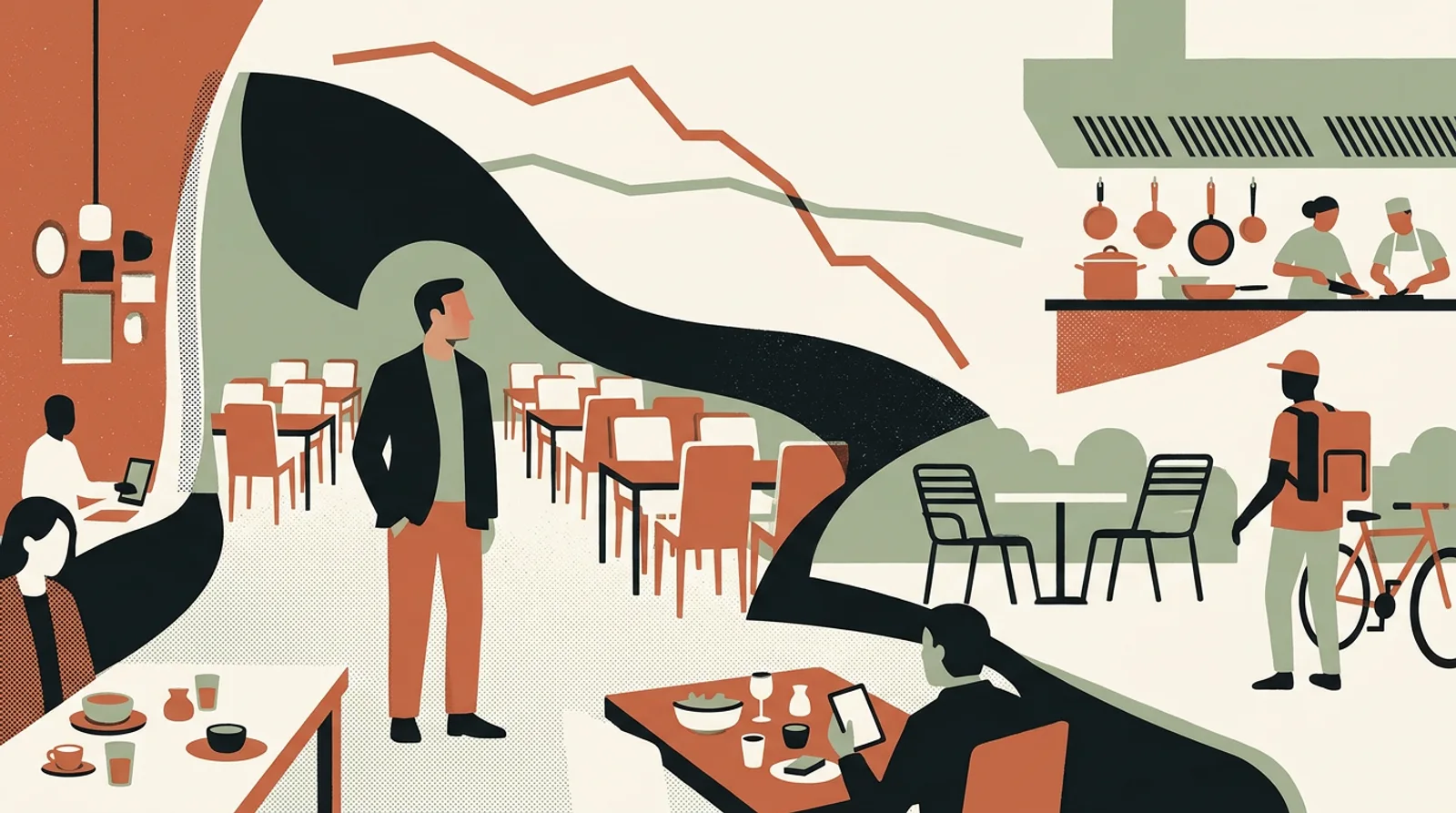
The room doesn't lie. It says what the menu, the service or the visibility can no longer tell.
The dip isn't temporary anymore. It's become the new baseline — and it's that baseline you have to learn to read, week after week, before pulling on any lever.
A quiet Tuesday says nothing. A quiet Tuesday across eight weeks, compared to the eight prior weeks with comparable weather and calendar, tells a story. Daily numbers are noise — it's the week-over-week gap, under comparable conditions, that becomes a usable signal.
Weather, school holidays or a shifted public holiday can skew the reading. Check them against an online weather log, or ask an AI to compare the two periods — you weight your reading in seconds.
A revenue drop comes from two opposite places: fewer people, or the same people spending less. The lever is not the same. If the check is falling and covers hold, the issue lies in the menu or in the table-side upsell. If covers collapse but those who do come spend just as much, the issue is in visibility or perception.
Type your name into Google, outside your usual session. Are your hours current? Is the main photo less than six months old? Do recent reviews still tell who you are today, or some restaurant that no longer exists? A lot of empty rooms start there — well before the question of price.
A 4.3-star average says nothing on its own. What speaks are the words that recur in the last 30 reviews. The frequency of terms like ''expensive'', ''slow'', ''noisy'', ''service'' or ''quality'' points to which axis is slipping in perception. It's free, and it's sharper than a market study.
If ''expensive'' shows up in more than one in five reviews, the issue is no longer price — it's value perception. And that doesn't get fixed with a discount.
The right benchmark isn't your best year — it's what two or three comparable places are doing right now: same area, same price range, same kind of service. If they're full and you're not, the issue is local and identifiable. If everyone is slipping at the same time, the issue is macro, and it calls for other levers.
Do
Don't
Situation
A downtown bistro logs −18% revenue over eight weeks. First reflex: the owner thinks about taking €2 off the lunch menu dishes to stop the bleeding.
Action
Once she splits her indicators, she sees something else: lunch covers hold, average check is stable, but dinner covers are down 12%. In the last thirty reviews, the word ''slow'' appears six times — only on the dinner service.
Outcome
The diagnosis wasn't a price problem but a kitchen pacing problem, hidden by the aggregate. The menu didn't move. The real lever — mise en place and the front-of-house / kitchen coordination on the dinner service — wasn't visible in the global numbers. A reflex price cut would have eaten the margin without touching the cause.
When ''expensive'' shows up in reviews, instinct says cut prices. It's almost always the wrong read. The customer isn't saying it's expensive in absolute terms — they're saying what they got didn't match the check they paid. Two different problems, two different levers.
A slow month after a full month isn't a trend, it's mean reversion. A trend is three months or more, compared to the same stretch a year earlier. Rushing to diagnose forces structural decisions onto simple noise.
They explain part of it. But if your comparable neighbors hold up in the same context and you slip, the external factor isn't the engine — it's the amplifier. The engine is inside, and that's what you have to look for.
You've just identified where it's breaking. Addressing it will take your time, your head, your energy. Meanwhile, your communication can't go dark — or turn into filler. Readytopost keeps it at a demanding level on the five social networks: posts written, images generated, calendar filled — calibrated on your restaurant.
Start with ReadyToPostKeep going on your own. The method for restaurants lays out the principles that turn a diagnosis into durable action — across every lever, not just communication. Concrete markers to help you decide between two services, without imposed recipes or rigid calendars. At your pace, at your scale.
Continue to the methodGoogle reviews don't just arrive — they're worked. Five concrete moves to place this week that turn a passive listing into a system of asking, answering and adjusting.
A tasting, a partnership with the wine shop next door, a one-off dish on a Thursday night: a short campaign can restart momentum — or devalue the rest of the menu and chip away at the margin without leaving anything behind. Five concrete moves to design it, frame it financially, and track it from Monday to Sunday.
A regular who used to come every week and now shows up every two months won't be won back by a marketing email or a discount. Five moves to place this week — named, written, measurable — to crack the door open without forcing it.
A specific service that's dragging — Tuesday night, Sunday lunch — doesn't need a full overhaul. Five moves placed this week are enough to shift the line the following week, without touching the menu or the prices.
platform-guides
Five platforms publish changelogs that document what each algorithm rewards. Almost nobody reads them. Here's what two years of release notes reveal.
platform-guides
Asphalte invites its audience to co-create the next collection — in public, on the same feed where it posts launches. The mechanism is documented and transposable. Here is how.
case-studies
Better work, fewer clients. Here is the case of an interior designer who solved the wrong problem first — and what she did differently the second time.
social-media-strategy
The jargon circulates. Here is what it means when you are the only person running your brand online.
There's almost always more than one cause. Three angles to separate: (1) covers (are fewer people coming?), (2) average check (are they spending less?), (3) perception (do reviews mention price, wait time or quality?). Until those three axes are measured separately, the diagnosis stays blurry — and any action taken on gut risks eating the margin without touching the cause.
Rarely, and never on reflex. If covers are dropping but the average check holds, it's not a price problem but a visibility or perception problem. If covers hold but the check is falling, it's the menu or the table-side upsell that's slipping. An untargeted price cut eats the margin on every customer, including the ones who would have paid without a word.
Look at the last 30 reviews. If ''expensive'' appears in more than one in five, that's a value-perception signal, not absolute price. The customer isn't saying it's expensive in absolute terms — they're saying what they got didn't match the check they paid. The slip is in the gap between expectation and experience, not in the amount.
Once a week is enough, as long as you compare to the same week a year earlier and neutralize weather and calendar (an online log or an AI handles it in seconds). Checking day by day produces noise and triggers rushed decisions on simple variance.
Three faint signals to watch: last-minute cancellations and no-shows climbing past 10%, regulars whose cadence drifts (from every week to every three or four), and recent reviews mentioning price or wait time more than the food. These three indicators often move before revenue visibly slips.