
Working Google reviews: the loop that lifts
Google reviews don't just arrive — they're worked. Five concrete moves to place this week that turn a passive listing into a system of asking, answering and adjusting.
A regular who drifts isn't angry. They stopped thinking about you. The move: get back into their head, not their inbox.
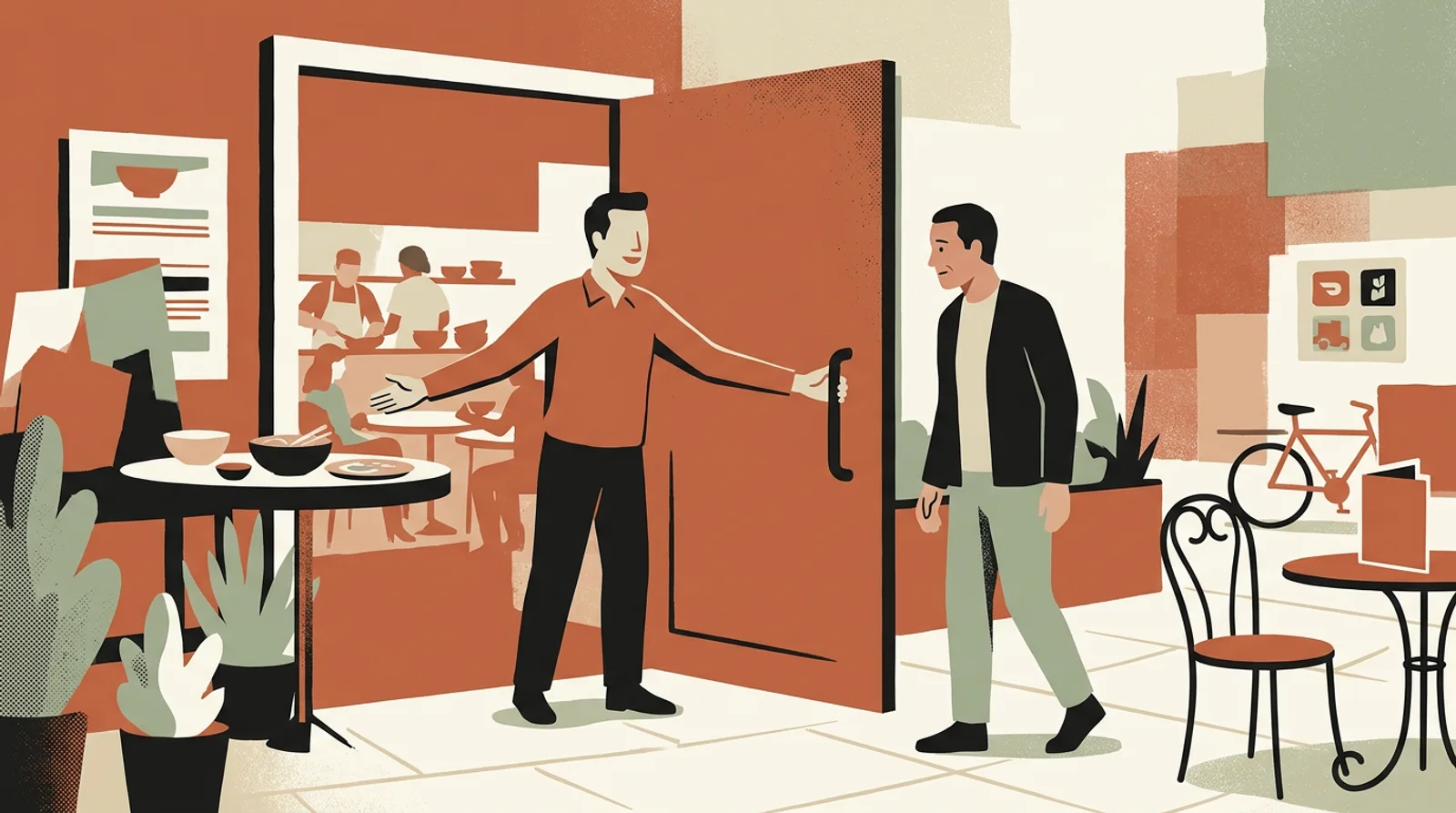
A restaurant improves through fifty small moves placed where they touch something. Practice gives you those moves, one at a time — each one applicable this week, readable the next. Here, five moves to crack the door open for a regular who''s drifting, without a discount that devalues, without a message that guilt-trips.
Open your booking software, your notebook, or simply do a round of the team at end of service on a Monday. Name the guests whose frequency has clearly dropped over the past two to three months — not every customer, just the ones you have a first name for, a face, and a sense of distance. Aim for five to ten names max. More and you''re running a disguised mass mailing. Less and you haven''t looked. What Make them return frames at the quarter plays out here case by case.
If you can''t name anyone, that''s already this week''s lesson: recognition of regulars isn''t surviving in the team. The move becomes setting up an end-of-service ritual so those names exist somewhere.
Put the list on the Monday or Tuesday briefing. For each name, one question only: what did we notice last time? A remark on a dish, a slightly off moment, a detail overheard without paying attention. Don''t hunt for THE cause — hunt for what was said. Fifteen minutes is enough for ten names. Write down what stands out in two or three words. Often nothing stands out — that''s information too: the guest didn''t leave for an identifiable reason, they just lost the habit.
A detail that recurs across two or three names (''wait'', ''dish changed'', ''table near the door'') becomes a room signal, not just a guest signal. Cross it with what [Read the room](/en/ressources/restaurant/diagnosis/read-the-room) says.
Personal SMS lands — generic email dies in the promotions tab. Write individually, from your phone or the restaurant''s, to one person at a time. No brand signature, no visual, no button. A short message, dated, signed with your first name. Template: ''Hi Claire, it''s Mark from the bistro. I realised we hadn''t seen you in a while — hope all is well. Talk soon.'' Nothing else. No ask, no offer. The point isn''t to trigger an immediate booking, it''s to signal you noticed. Half won''t reply, half will — and a third will be back within the month.
Avoid the word ''long'' which lands like a reproach. Use ''in a while'' or ''these past weeks''. The nuance changes everything on the receiving end.
A discount on a guest who liked you at full price devalues what they were buying yesterday. Give a specific reason instead: a new dish that matches what they used to order, an event (wine evening, a chef back from leave, the house anniversary), a direct ask (''I''d love your opinion on the new menu, coffee''s on me''). Template: ''I''ve added a mushroom risotto this week — I remember you liked the one we ran last autumn — drop in whenever.'' The lever is specificity, not the price cut. A short campaign like the one described in Running a short campaign can also provide a legitimate occasion, without devaluing.
If the guest always orders the same dish, signal the return of a seasonal ingredient that concerns them. You''re showing you know them — that''s what cracks the door, not the price.
Write down the date of each SMS sent and the date of return (or not). Give yourself three weeks, no more. Out of ten well-placed outreach moves, count three to four returns in the month — that''s the order of magnitude. For the other six or seven, do not send a follow-up. A second ''we miss you'' tips into guilt-trip and burns the relationship for good. A respectful silence for six months and a new gesture on a real change (new chef, new menu) beats insistence that turns the guest into a target.
Keep a mini-table: name, SMS date, return yes/no, possible next move in 6 months. Three columns, ten rows. That level of precision is enough — past that, it''s CRM, and CRM doesn''t save a guest who''s drifting.
Do
Don't
Situation
A neighbourhood trattoria notices four regulars are missing — they''d been coming every Monday or Wednesday for two years. Team reflex: add the four to the mailing list for the next ''-15% on the menu'' campaign.
Action
The owner cuts that off. Monday briefing: team round on the four names (nothing stood out, except for Claire whose husband changed shifts). Four SMS written Tuesday night, signed by the owner, each one different — for Claire: ''If Tuesdays work better than Mondays now, we''re always keeping table 6 for you.'' For Antoine: ''The salmon in brown butter you used to love is back on the menu.'' No discount, no visual, no link.
Outcome
Three weeks later: Claire came back on Tuesday (and has stayed since). Antoine came once and hasn''t returned. The other two didn''t reply, and the owner didn''t follow up. Out of four outreach moves, two useful returns — a rate that lines up with what you see when this move is done well. Cost: zero, twenty minutes of kitchen prep skipped on Tuesday night to write four messages. No price devaluation, no ''customers in decline'' list that would''ve eventually coloured the team''s perception.
A personal SMS signed with a first name isn''t a ''marketing SMS channel''. The moment you push it through a bulk-send platform, even with first-name personalisation, the message flips to commercial — and the guest feels it in the first second. Rule: if you can''t write the ten messages by hand in under thirty minutes, you''re on the wrong move.
A discount in a first contact says two things to the guest: they were worth full price before, but not anymore. And that you need to fill seats, not see them. Both devalue the relationship. If a discount has to exist, it comes second, after a return, and always on a non-transactional pretext (a coffee on the house for their opinion, never 15% off).
The first message is a signal — the equivalent of a smile across the street. The second becomes a request. The third, pressure. A regular who hasn''t replied in three weeks heard your signal and chose not to act on it now. Pressing burns the chance of a spontaneous return later. Better to leave them alone and keep a fresh reason for six months out — a real change, a real new thing.
Pulling these levers every week is already a discipline. Adding communication on five social networks is another — and the one that gets sacrificed first. Readytopost takes the second one off your plate: posts, images, scheduling, calibrated on your restaurant. So the first one keeps all your attention.
Start with ReadyToPostBack to the overview for restaurants to browse all guides — diagnosis, method, practice — in whichever order fits. Three floors that complement each other: one to understand, one to think, one to act. You go in where it pinches most today, and come back when a new question shows up. No required order.
Back to the overviewGoogle reviews don't just arrive — they're worked. Five concrete moves to place this week that turn a passive listing into a system of asking, answering and adjusting.
A tasting, a partnership with the wine shop next door, a one-off dish on a Thursday night: a short campaign can restart momentum — or devalue the rest of the menu and chip away at the margin without leaving anything behind. Five concrete moves to design it, frame it financially, and track it from Monday to Sunday.
A specific service that's dragging — Tuesday night, Sunday lunch — doesn't need a full overhaul. Five moves placed this week are enough to shift the line the following week, without touching the menu or the prices.
Loyalty isn't a stack of nice gestures — it's a system. Five principles to think about return visits by the quarter, not by the week, and stop mistaking a punch card for actual loyalty.
platform-guides
Five platforms publish changelogs that document what each algorithm rewards. Almost nobody reads them. Here's what two years of release notes reveal.
platform-guides
Asphalte invites its audience to co-create the next collection — in public, on the same feed where it posts launches. The mechanism is documented and transposable. Here is how.
case-studies
Better work, fewer clients. Here is the case of an interior designer who solved the wrong problem first — and what she did differently the second time.
social-media-strategy
The jargon circulates. Here is what it means when you are the only person running your brand online.
No — and it''s counter-productive on this profile. A regular came at full price because they thought it was worth it. Offering them 15% signals you''re now doubting the value you were selling yesterday. The lever that works on a drifting regular is personal recognition — a message that shows you noticed they were gone and you know them well enough to mention a specific dish or detail. Keep the discounts for new-customer acquisition, where they make sense. On winbacks, the intact price protects the relationship.
Count roughly one guest in three who comes back within the month after a well-placed personal outreach — short message, signed with a first name, containing a specific reason. That''s ten times higher than a mass marketing email with a promo code, which usually caps at 2 or 3%. Out of ten outreach moves, you''ll see three to four guests again within three weeks. The others won''t come back — either they''ve left the neighbourhood, or they''ve moved on. That''s neither a failure nor a signal to press: it''s the normal mechanics of the move.
No universal threshold — it depends on their original frequency. A guest who came every week and now comes every three weeks has clearly drifted. A guest who came once a month and now comes every two months is still inside a normal swing. The right marker is the relative gap: a frequency divided by half or more, observed over two to three months, is the actionable signal. Below that, you risk reacting to noise. Beyond that, you''ve waited too long and the relationship really has faded.
Nothing, for at least six months. A non-reply isn''t a refusal — it''s a message that says ''not now, but I saw it''. Pressing with a second message turns the smile into a request, then into pressure. Rule: one SMS, measured over three weeks, then silence. After six months, if a real change happens (new chef, new menu, house anniversary), you''ve earned the right to try again — with a fresh reason, not a follow-up. In between, you leave the door open without pushing it.
You''ve got two options. Either you wait for their next spontaneous visit to reconnect in the room (''Glad to see you back, I thought of you when we brought the risotto back'') — less active, but it works. Or you check whether you have their number from a past booking on your software (TheFork, Zenchef, SevenRooms keep contact history). If you really have nothing, this week''s lesson lies elsewhere: it''s time to set up a simple number capture at booking for regulars who come back, without turning it into a marketing file — just a memory tool.