Social media content ideas that get posted
Social media content ideas for a small business: the ones drawn from this week's work get posted, a saved list of fifty never does. Here is the system.
The social media content ideas that get published by a one-person business come from the week's work: a job finished, a material chosen, a repair that went sideways, a price someone asked about. A saved list of fifty topics produces almost nothing, and the reason is mechanical, not creative.
Nadia shows why. She is a composite, not a client: one upholsterer standing in for any solo workshop that has tried to run a feed from a list. Her notes app holds 47 content ideas. The oldest is 14 months old. In that time she has published four posts.
Why 47 ideas produced four posts
Read her list and nothing is wrong with it. "Behind the scenes." "Share a client story." "Explain why good fabric costs more." "Before and after." Every line is a legitimate idea. Every line is also a category.
A category has no date and no asset. "Before and after" can be posted any week, so it gets posted no week. It also needs two photos Nadia has to go and find, from a job she has to pick, with a caption she has to invent from scratch. Three decisions stand between the idea and the post, and each one is a place to stop.
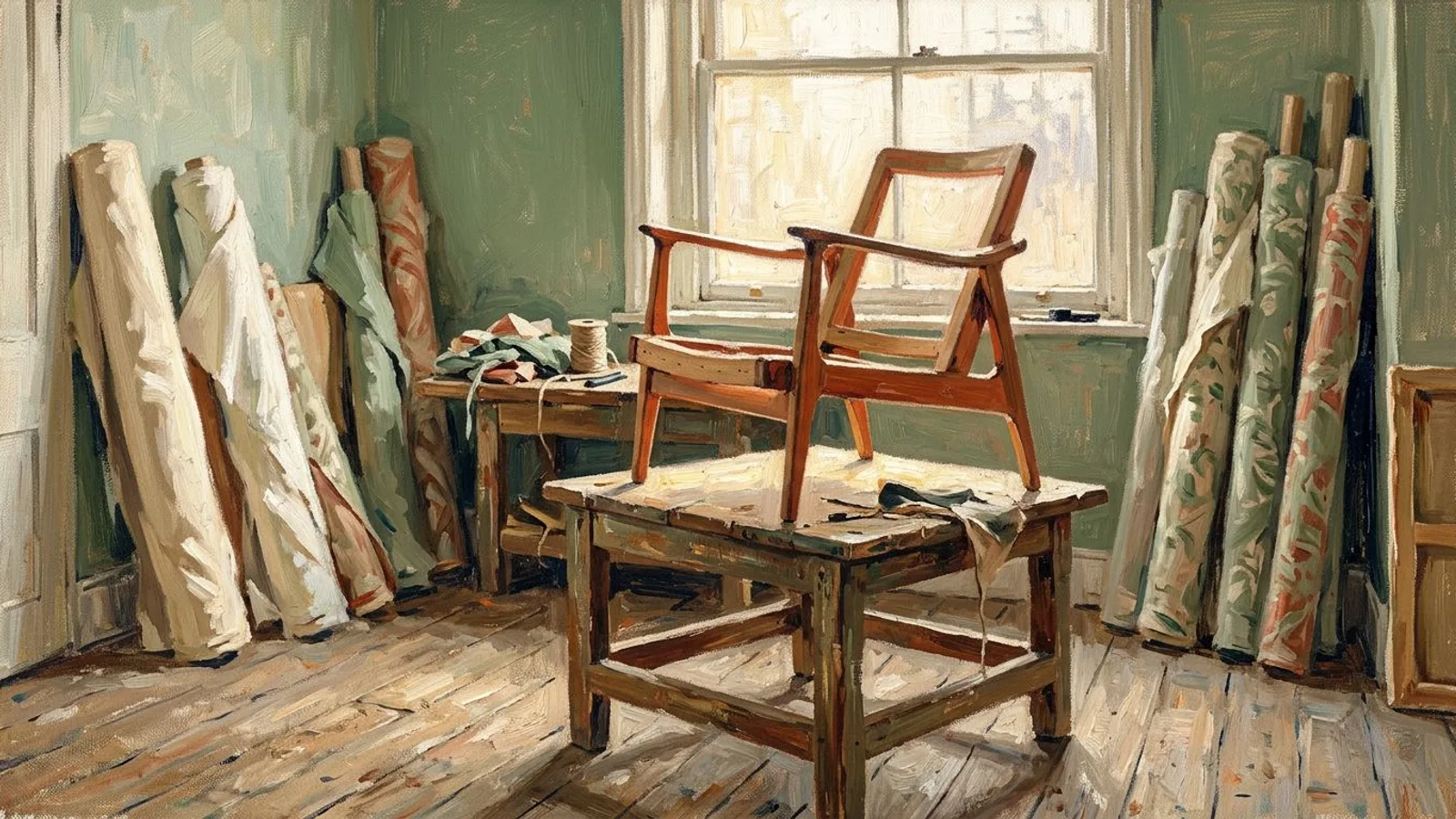
Compare that with the thing that actually happened on Tuesday. A 1960s armchair came in with the seat webbing gone, and the owner wanted the original fabric saved. That is not a category. It carries an object, a decision, and a photo she already took for the client. The first sentence of the post writes itself. Nothing is left to invent, only to describe.
This is the whole mechanism. An idea becomes a post when it arrives with its own constraints. The list strips the constraints out, which is why it looks so reusable and ships so rarely.
What should a small business post on social media?
The useful answer is not a list of topics. It is a list of events your business already produces every week. Here are the ones that fill Nadia's feed now. Each exists in some form in every trade.
- The job that came in. What arrived, what state it was in, what the client asked for. One photo on arrival is enough.
- The choice you made. Which fabric, and why not the other three. A decision explained is the most specific thing you can post, because no competitor made exactly that one.
- The thing that went wrong. The frame that split, the fabric that arrived in the wrong color. A problem solved in public is the post people save.
- The price someone asked about. Take the question you answered by email and answer it where everyone can read it. Give the number if you can.
- The job you turned down. What you do not do, and why, tells people what you do.
- The finished piece leaving. The one post everyone already makes. It works better with the arrival photo next to it.
- The material that arrived. A delivery of hessian and horsehair is boring to Nadia and interesting to everyone who has never seen the inside of a chair.
Each of these is dated. Each comes with a photo taken for another reason. Each expires: if the armchair post is not up by the time the next chair is on the stand, it goes stale. That expiry is a feature. It is what gets the idea posted.
An idea that can be posted any week gets posted no week. The ones that ship are the ones that expire.
How do you come up with content ideas every week?
Nadia stopped brainstorming. She replaced it with a five-minute log at the end of the week. For each piece on the stand, one line: the object, the decision she made, and which photo she has. Four pieces, four lines. That log is the content calendar.
The step she did not expect: the log made a text generator useful for the first time. She had tried one before, typed "write an Instagram post about quality upholstery," and got the paragraph every upholsterer in the world would get. That is not the tool failing. Ask for a category and a generator returns the statistical middle of every post ever written about that category, because you gave it nothing else to hold onto. Ask it about a 1960s armchair with the seat webbing gone and the original fabric to save, and the middle is no longer available. It has to write that chair.
You can test this in thirty seconds. Take any idea from a listicle and try to write its first sentence for your business without opening your camera roll. If you cannot, the idea is a category. Now take one line from your week and try again.
The same log answers the flat week. When nothing happened this week in the news sense, four chairs still came in, and each one carries its own post.
How many content ideas do you actually need?
Fewer than any list suggests. Nadia publishes three times a week: the arrival, the choice, the finished piece. That is twelve posts a month from about eight jobs, with material to spare. Fifty ideas was never the target. Three logged events a week is.
Where they go depends on who books her. Reupholstery is a search category on Pinterest, so the finished piece with the arrival photo beside it does long work there. Instagram and Facebook carry the week as it happens for the people nearby. She no longer adapts each post by hand for each network. That was the 30 minutes per platform that killed the list the first time. Writing the event once and letting the week get published across the networks she actually uses is what turns three posts a week into a steady presence instead of a good month.
The schedule matters less than the source. Once the ideas come from the log, a month planned in one sitting is just the log with dates on it.

Eight weeks later
The notes app still holds 47 ideas. Nadia has not opened it. The feed has 24 new posts, all of them about chairs that existed. Two clients mentioned the split-frame post when they booked. She has one new rule, and it is not about content: every piece gets an arrival photo before she touches it. The post is a side effect of the photo.
If your own list is long and your feed is quiet, the fix is not a better list. Delete nothing. Stop reading it, and start logging the week.
FAQ
What are good social media content ideas for a small business?
The ones tied to something that happened: a job in, a decision made, a problem solved, a question answered, a piece finished. Topics without a date rarely get posted.
How do I find content ideas when nothing new is happening?
Log the ordinary work. A routine job still contains an arrival, a choice, and a result. Routine to you is unseen to your audience.
How far ahead should I plan content ideas?
One week of logging feeds one week of posts, and a month of logs can be scheduled in a single sitting. Planning further than your log reaches puts you back on the topic list.
Should I reuse a content idea?
Reuse the format, not the post. "The choice I made" can run every week with a different job. That is a series, not a repeat.
Do I need different content ideas for each network?
No. You need one event and a version of it for each network you actually use. The idea stays the same; the length and the picture change.