First Instagram post ideas for a new business
First Instagram post ideas for a new business: what to publish, in what order, and why your first posts really get read later, on your profile.
The strongest first Instagram post for a new business is an introduction: one real photo of your work, and a caption that says who you are, what you make, and who it's for. That's the standard answer, and it's correct. It just skips the fact that changes everything about how you write it: almost nobody will see that post on the day you publish it.
Take Maren — a composite of the makers we've watched open a business account this year. She fires stoneware mugs in small batches and has just set up her online shop. Her account shows zero followers. She has spent four days rewriting one caption, because everything she reads tells her the first post sets the tone.
Here is what the numbers around her actually look like.
Who really sees a first post?
A feed post reaches followers first. With zero followers, a first post reaches close to zero people on publication day. Hashtags and the explore page add a trickle of views, not an audience. Whatever Maren publishes today will be seen by her mother, two friends, and almost no one else.
That sounds discouraging. It's the opposite. It means there is no opening night: the first post's real audience arrives over the following months. The customer who finds one of her mugs at a market, the shop owner she emails, the person who saw her label — each of them opens Instagram and checks her profile before deciding whether she's worth following, or buying from.
Those visitors don't read her first post as "the first post." They read it as the bottom tile of a grid. Put yourself in the visitor's place and the stakes are clear: a profile visit almost never turns into a follow when the grid shows one or two posts. From about six posts — a full screen — the visitor has enough to decide. The first post's job is not to launch anything. Its job is to hold its place on that screen.
So what do you actually post first?
Write the introduction post — but write it for the profile visitor of month three, not the feed of day one. Concretely, that changes three things:
- No opening announcement. "We're live!" posts age badly: by the time your real audience reads them, the launch is old news. Say who you are, what you make and for whom, in the present tense — it will still be true in six months.
- One real photo of the work. Not the logo on a colored background — a logo tile tells the visitor nothing about the only question on their mind: whether those mugs are worth their 34 euros.
- A caption that could sit anywhere in the grid. If it only makes sense as a "first post," it will read like a leftover later.
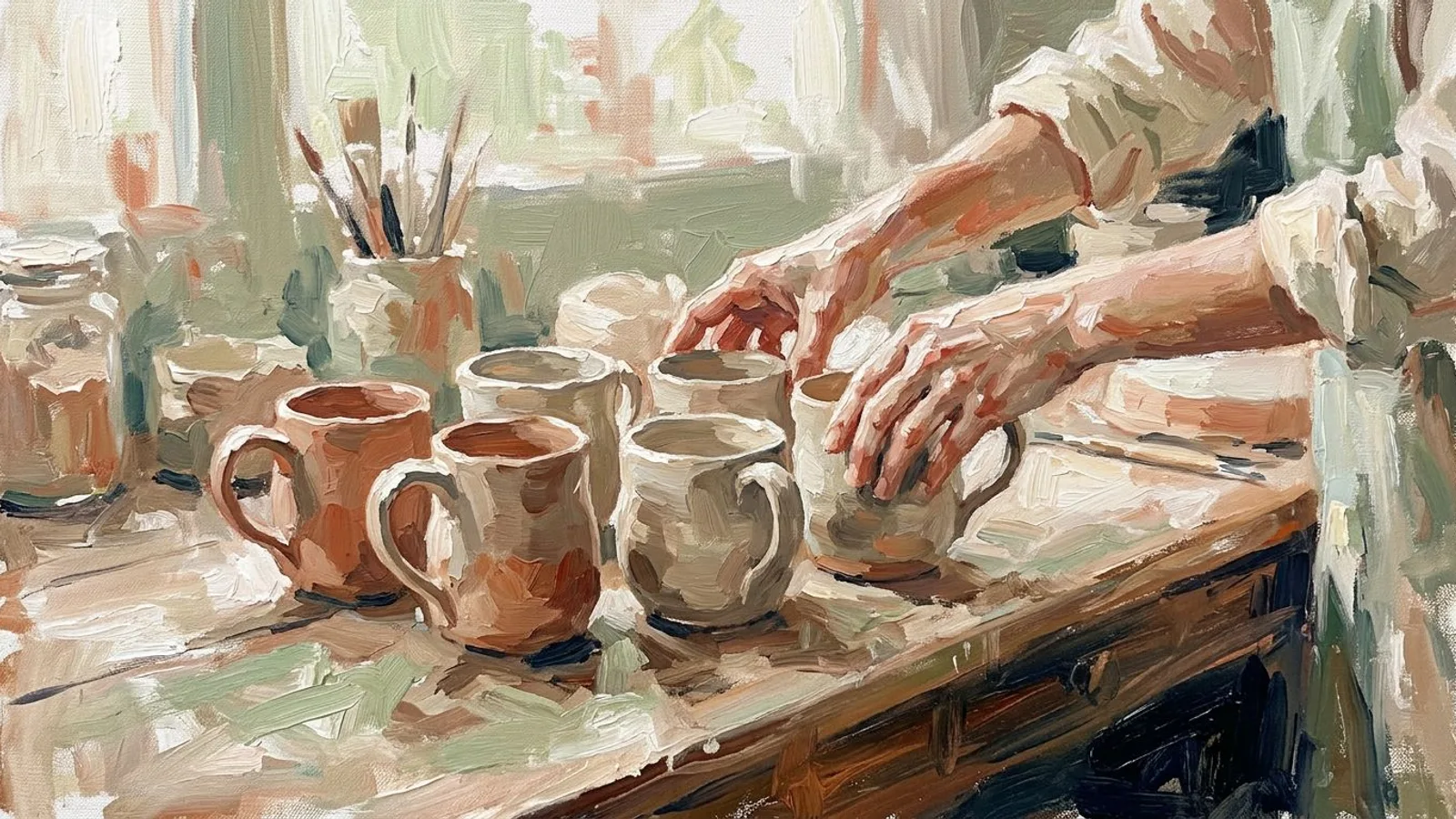
For Maren, that means: a photo of six mugs on the workbench, still unglazed, and four sentences — what she makes, in what batches, where the shop is. No countdown, no ribbon-cutting.
A profile visit almost never turns into a follow when the grid shows one or two posts.
Nine post ideas that work as a set
Since your first posts will be read together, as a grid, the useful unit is not one post idea — it's a set. These nine cover what a profile visitor wants to know about a new business, and they don't expire:
- The introduction — who, what, for whom.
- The product, close up — one piece, filling the frame.
- The process — hands, tools, the stage before the finished piece.
- The place — where the work happens, even if it's a corner of a kitchen.
- The material — what things are made of and why you chose it.
- The range — what exists today, in one image.
- The price, explained — what goes into what it costs. This is the post small businesses avoid, and the one that gets read most closely.
- A use scene — the product in someone's life, not on a shelf.
- Where and how to buy — plainly, once per screen of grid.
Each of these answers a question the visitor silently asks. Together they do the work of a website's about page — on the platform where your customer already spends time. If you want that set drafted from what your website and photos already say, that is exactly what an Instagram post generator tuned to your brand is for: it produces the starting set in your voice, you review it, fix what sounds off, and publish on your own schedule.
Three first posts, written out with their captions
The nine above are categories. Here is what the first one looks like finished, for three kinds of business. Copy the shape, not the sentences.
A maker. Photo: six unglazed mugs on the workbench, tools still in the frame.
I throw stoneware mugs in batches of about thirty, in a workshop behind the house. Each one is trimmed and glazed by hand, so no two come out the same. They hold 300ml, they go in the dishwasher, and they are built for a Tuesday morning rather than for a shelf. The shop is open, link in the bio.
A service business. Photo: the desk mid-job, the actual work visible, no laptop-and-coffee staging.
I rebuild the books for small companies that have outgrown a spreadsheet. Usually that means a founder doing invoices at eleven at night and no longer knowing what the month looks like. I take that over, monthly, from the receipts you already have. If that is your month-end, the contact link is in the bio.
A food business. Photo: one loaf, cut, on the counter where it was made.
We bake sourdough three days a week with flour milled twenty kilometres away. One loaf ferments for two days, which is why it keeps for four and why we only make what sells the same morning. Wednesday, Friday, Saturday, from seven. First come, first served.
What these have in common is worth more than the wording. Each one names what the business makes, who it is for, and one concrete detail a competitor could not copy in a sentence: the batch size, the eleven-at-night problem, the two-day ferment. Each is written in the present tense, so it still reads correctly in six months. And none of them announces anything: no launch, no countdown, no "we're finally live". The caption that ages well is the one that describes what is true, not what just happened.
The length is four or five sentences, not forty words and not three paragraphs. A profile visitor reads the first line and decides whether to read the second. Put the thing you make in that first line.
How fast should the first posts go out?
Faster than feels natural. Not one per month: the grid needs to reach that six-post screen before the first real visitors arrive. A steady rhythm over two or three weeks gets you there — nine posts, one every second day, and by week three the profile reads like a business that exists.
What kills new accounts is not posting the wrong thing. It's the two-post profile frozen since March — every visitor reads the gap between the dates, and an abandoned grid answers the question "is this business still running?" for you, in the wrong direction. The mechanics of a launch week are the same for an account as for a product — the sequence in this guide to launching a product in a week of posts transposes directly to opening an account.
Maren published her nine posts over eighteen days, then dropped to two per week. Her follower count in week three: forty-one. That number didn't matter. What mattered: a wholesale buyer she had emailed opened her profile in week five, saw a full grid, and replied. The first post did its work five weeks after it went up — as the last tile the buyer scrolled down to, not as the first post anyone watched go by.

What happens after the nine?
The set gets you a profile that turns a visit into a follow. What builds after that is regularity — the account that keeps publishing week after week. That's a different mechanism, on a different pace, and it's covered in why Instagram rewards the ones who keep showing up. The short version: the first nine posts earn the follow; the steady presence afterwards earns the sale.
The first post you keep rewriting is a tile. Write it so it holds its place on a screen of nine, publish it, and start on the second one today.
FAQ
Should the first post introduce me or my product?
Both, in one post: a real photo of the product, and a caption that says who makes it and for whom. A logo-only post tells a profile visitor nothing.
Do I need followers before I publish?
No. It works in reverse: the grid you build with your first posts is what turns later profile visits into follows.
Is it bad if my first post gets no likes?
No — on a new account, that is the normal case. The post's real audience arrives later, through your profile. Judge it in month three, not on day one.
How many posts before I mention prices and how to order?
Put one post with buying information among your first nine. A visitor who wants to buy should not have to dig; one clear post per screen of grid is enough.