Faceless content ideas for a small business
Faceless content ideas for a small business: what the famous 38% face study measured, what Instagram penalizes, and 12 posts that prove you made them.
The faceless content ideas that work for a small business show the work instead of the worker: your hands at a skilled step, the raw material, the bench or counter, the before-and-after, the order on its way out. What decides whether they perform is not the missing face. It is whether each post proves that you made it.
That second sentence is where a short investigation ends. It starts with a number almost every "show your face" argument carries, and it finishes with a rule Instagram extended in April 2026.
Where does "posts with faces get more likes" come from?
The number is 38 percent. It comes from a paper presented at CHI 2014, the leading conference on human-computer interaction: "Faces Engage Us," by Saeideh Bakhshi, David Shamma and Eric Gilbert, researchers at Georgia Tech and Yahoo Labs.
The team ran face detection software over 1.1 million Instagram photos. Photos with a human face were 38 percent more likely to receive likes and 32 percent more likely to receive comments. The researchers controlled for each account's follower count and posting activity.
Read past the headline, though, and the paper says less than the people who quote it.
The number of faces in a photo made no difference. Neither did their age or gender. A child, a group of friends, a single adult: same lift. That points to human presence as the pull, rather than any particular person.
The metric matters too. The study measured likes and comments on a large sample of Instagram photos. It says nothing about bookings, orders, or whether a stranger trusts a business. It never tested a pair of hands either, so nobody should claim it proves hands work as well as a face. It shows that presence matters. It does not show that your face is the only way to supply it.
Does Instagram penalize faceless accounts?
No. What Instagram penalizes is borrowed content, and that line moved this year.
On April 30, 2026, Instagram extended its originality rules to photos and carousels. Accounts are assessed over a rolling 30-day window. If most of what an account posts in that window is content it did not create, Instagram treats it as an aggregator. Its photos and carousels stop being recommended in Explore and the other discovery surfaces. Existing followers still see them. Strangers no longer do.
Instagram's own examples of original content include photo series, how-to guides and visual stories. Low-effort edits, like adding a watermark to someone else's image, do not count.
This is where most faceless content lists go wrong for a business. Their ideas lean on material you did not make: quote cards lifted from other accounts, stock flat lays, trending templates. A faceless feed built on that is exactly what the rule now keeps away from new people. A faceless feed built on photos of your own work sits on the right side of it, whether your face ever appears or not.
It shows that presence matters. It does not show that your face is the only way to supply it.
What does a face do that a faceless post has to replace?
Side by side, the two sources show a face doing two separate jobs.
The first job is presence. A person in the frame tells the scroller that a human is behind the post. That is the effect the 2014 paper measured.
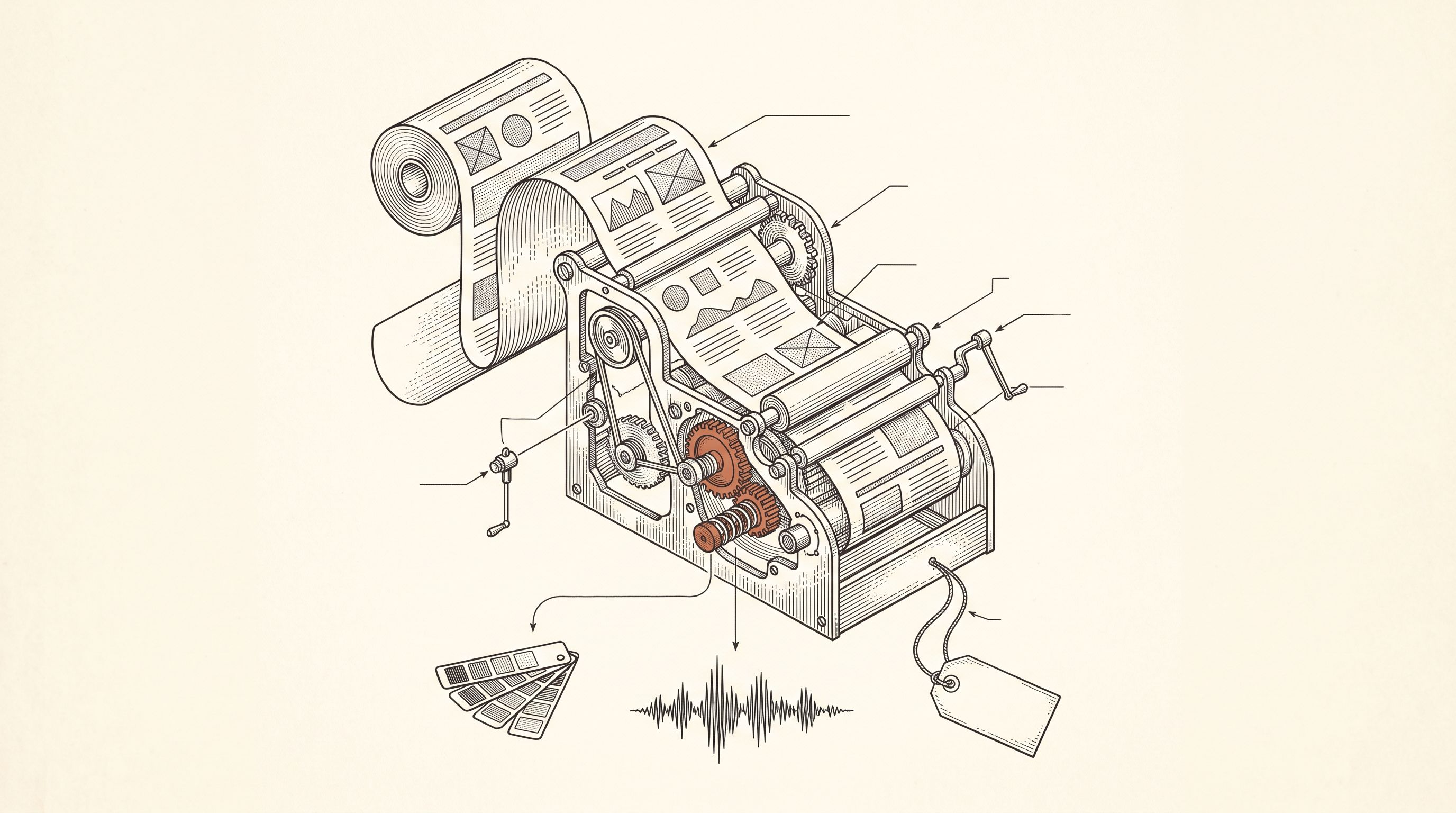
The second job is recognition. Your face looks the same in every post, so a follower learns to spot you before reading a word. Take the face away and that signal has to come from something else that repeats: the same worktop, the same light, the same tool, the same way of framing the product.
Most weak faceless posts fail one job, not both. A clean flat lay shot the same way every week has recognition but no presence. A hand holding a coffee cup has presence, but it could belong to any café on earth. The ideas worth posting do both jobs at once, and they almost always come from this week's actual work rather than a saved list.
Faceless content ideas for a small business, sorted by job
Each idea below uses material your week already produces.
Presence without a face
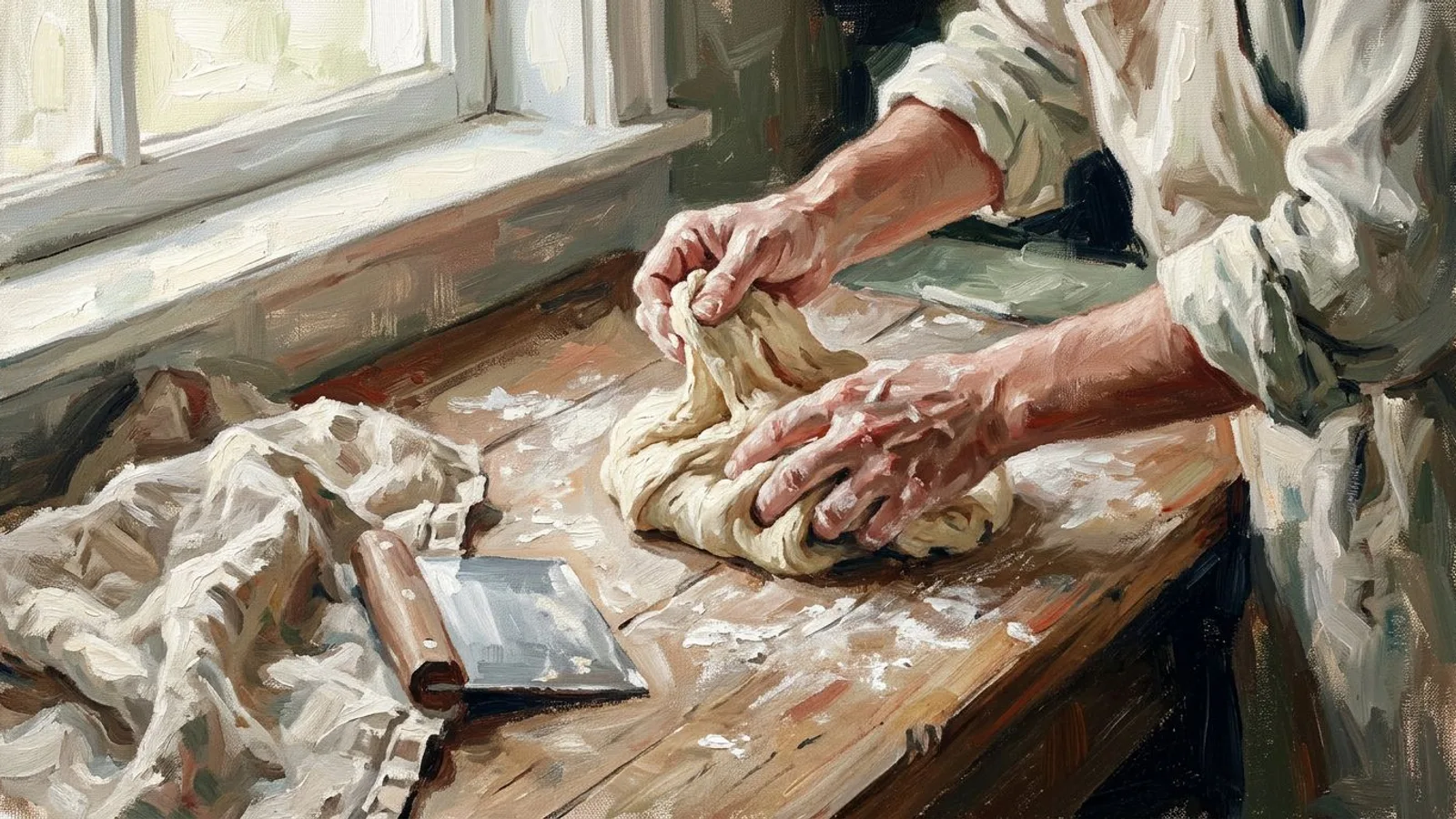
- Your hands at the step that takes skill: the fold, the stitch, the glaze, the cut.
- The half-finished piece, with the tool still lying next to it.
- A handwritten note tucked into an order. Handwriting is as personal as a face.
- The end-of-day bench, shot straight on: flour, offcuts, open jars.
Recognition without a face
- One fixed spot in your space, photographed from the same angle every week, showing what changed.
- A recurring series with a fixed name, like the material of the week. Instagram names photo series as original content.
- The same surface under every product shot, so a follower spots your post before reading your name.
Proof without a face
- A before-and-after taken from the same angle.
- The order leaving: box, label, destination city.
- A customer's review set as a text card, with permission, in their words rather than your summary.
- One number from your week, stated plainly: 42 bouquets, 11 fittings, 3 kilos of dough before 7 a.m.
- A how-to carousel on one step of your process. How-to guides are on Instagram's list of original formats.
If you make things by hand, our guides for makers go deeper on turning each production step into a post.

Can AI make faceless posts that don't look like stock?
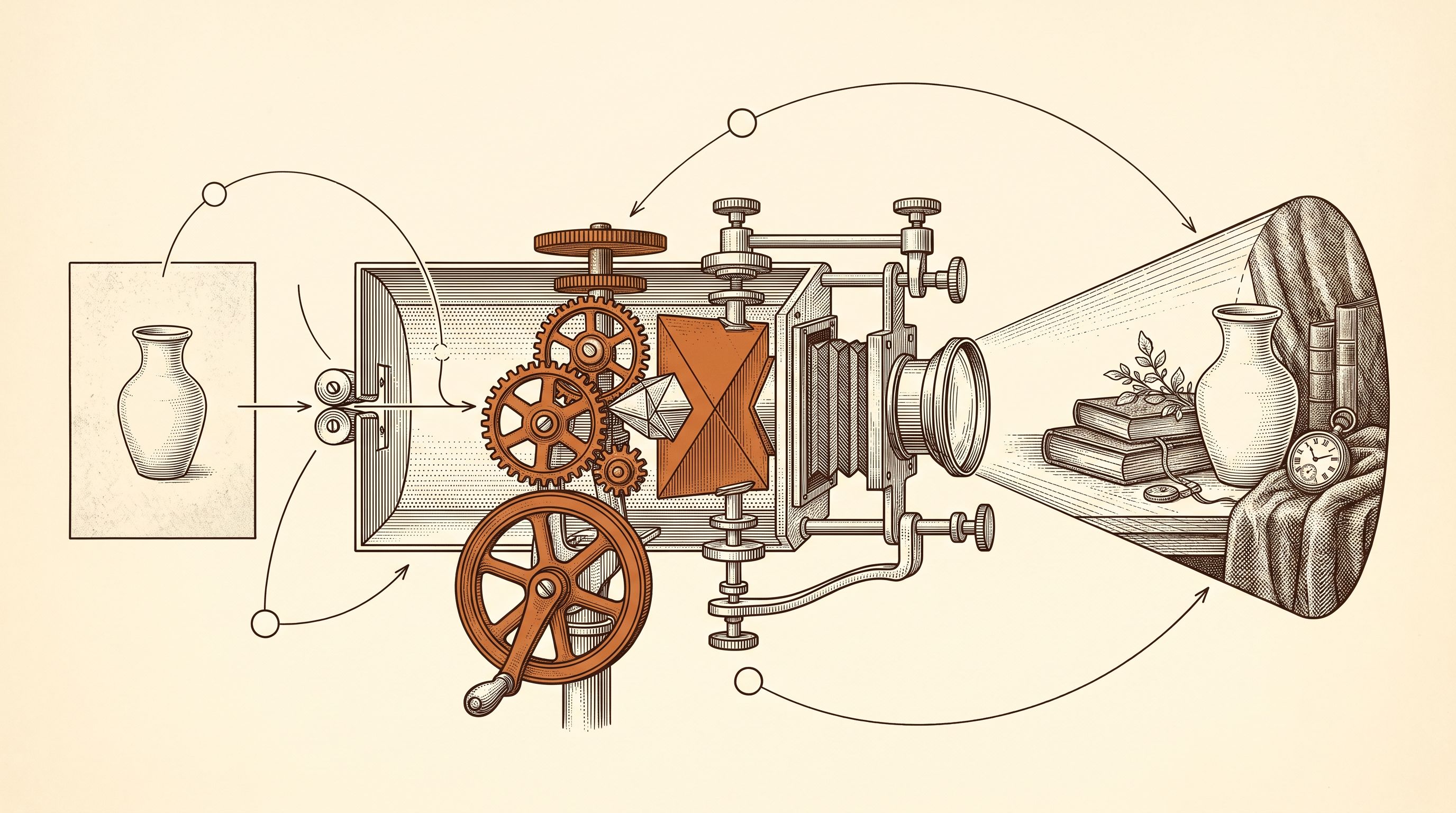
Yes, as long as it starts from your material. Here is a 30-second test. Ask any image generator for "a faceless Instagram post for a bakery." Then ask again for a different bakery in another town. Chances are you get two near-identical images: floured hands, a wooden board, soft window light. With nothing specific to work from, a generator draws the most typical version of the scene.
That default fails the recognition job completely. It is also the image your competitor gets from the same prompt.
The fix sits on the input side. When the generator works from a photo of your actual bench, your actual product and the palette of your website, the hands land on your worktop, next to your packaging. That is what visuals generated from your own photos and brand change: the image carries your recognition signals instead of the category average. Captions work the same way: built from the facts on your site, they name your materials and prices instead of "handcrafted with love."
The originality rule is not the obstacle here. It targets accounts that mostly repost other people's content, and a new image of your own work is not a repost. Whether a person or a model drafted it is a separate question, and no network downranks a post for being AI-made. What decides the result is the input, which is the principle behind Instagram posts generated from your own site and photos.
This week, pick the step of your work that takes the most skill. Photograph your hands doing it from the same spot on three different days. That is a series, it is original, and by the third post it is recognizably yours.
FAQ
Is faceless content good for a small business?
Yes, when it shows your own work. Faceless posts built from your photos keep both presence and recognition. Faceless posts built from borrowed quotes or stock images lose both.
Can a faceless Instagram account still grow?
Yes. Instagram's 2026 rules limit accounts that mostly repost content they did not create, not accounts without a face. A feed of your own photo series and how-to carousels counts as original.
What are the easiest faceless posts to start with?
Hands at a skilled step, a before-and-after from the same angle, and a customer review set as a text card. All three use material you already have this week.
Do faceless posts work on Pinterest?
Pinterest leans faceless by nature. People search it for objects, places and steps rather than personalities, so process shots and how-to images fit it well.
Should I ever show my face?
If you are comfortable with it, now and then. The 2014 study found any face lifted likes, whoever it belonged to. But a feed can run on your hands and your work alone.