

Working Google reviews: the loop that lifts
Google reviews don't just arrive — they're worked. Five concrete moves to place this week that turn a passive listing into a system of asking, answering and adjusting.
The warmest welcome doesn't hold if the system around it doesn't.
_The method isn''t a yearly plan — it''s the step back, around the quarter, that lets the calls hold up past Sunday. Welcome is no exception: as long as it depends on the person on the floor, it doesn''t depend on the house. That shift from ''service'' to ''system'' is what this method names._
The first contact is almost never the server''s hello. It''s the phone ringing in the void at 11am, the booking confirmation that doesn''t arrive, the unreadable sign out front, the parking spot you can''t find, the Google listing that says ''open'' on the day you close. Everything the customer goes through before crossing the door is part of the welcome — and the floor team inherits a tense or a calm guest depending on what played out before. The method starts by mapping those out-of-room touch points.
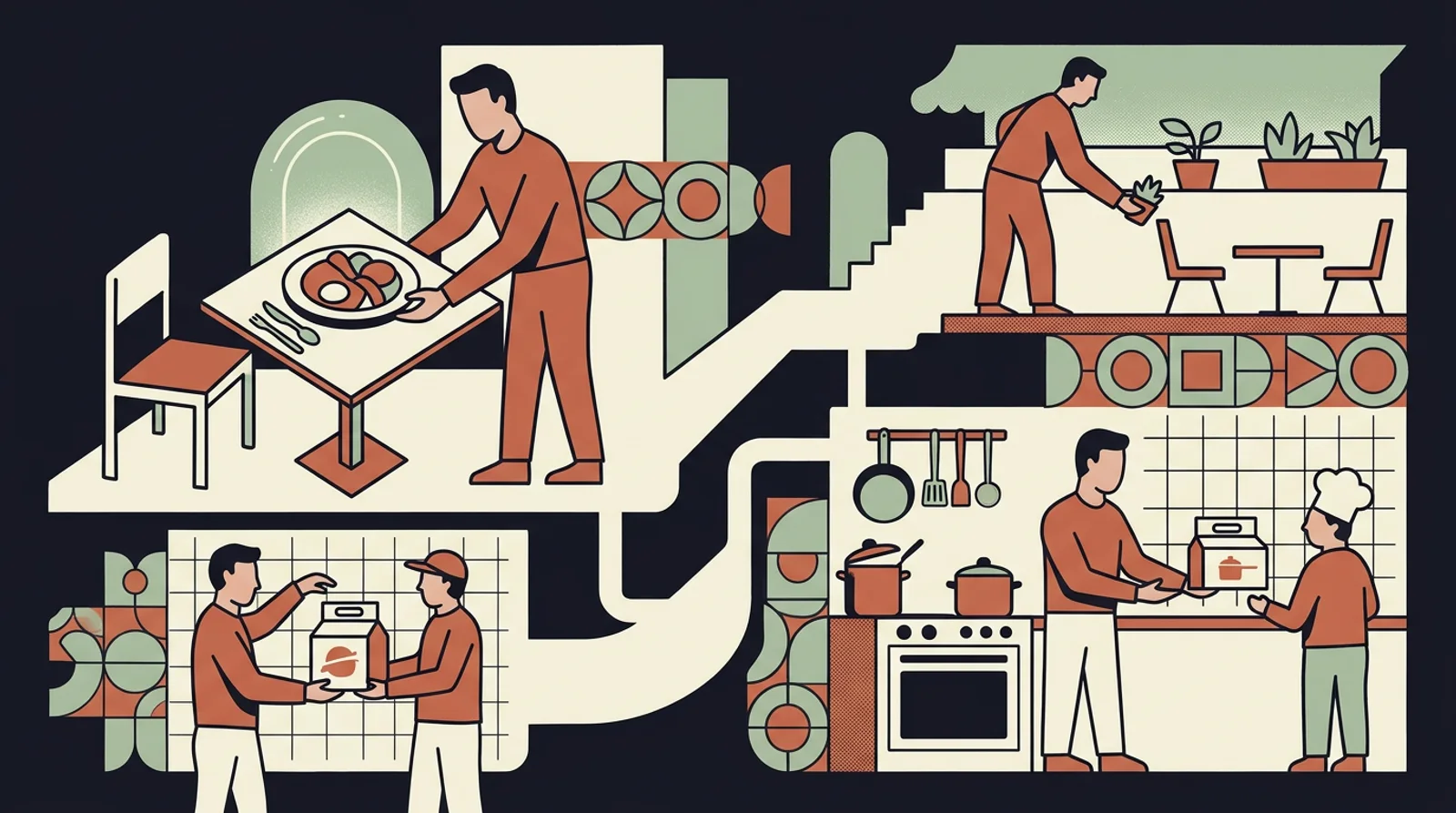
A systemic welcome breaks down: (1) before arrival, (2) the first ten seconds in the room, (3) seating at the table, (4) taking the order, (5) the wait between courses, (6) end of meal and the bill, (7) the goodbye. Each moment has its own risk and its own key gesture. Until all seven are listed and discussed in the team, the welcome stays an individual instinct — not a house. The same grid applies to the room reading method: you only correct well what you''ve separated out.
Writing a script — ''Good evening, welcome to X'' — always produces the same outcome: the team recites it, the customer hears it, no one believes it. What gets framed isn''t the line, it''s the intention of the moment and the result expected. For arrival: ''the guest must be looked at within ten seconds, even if we can''t seat them yet''. For waiting: ''any table waiting more than five minutes sees someone pass''. The frame says the what and the why; the wording stays with the person.
A rigid frame makes the team look robotic to the guest. A vague frame leaves them improvising without a net. The method sits between the two: define the result expected (the guest must feel anticipated, heard, considered) and let the person on the floor pick the gesture. Two things follow: train the team to improvise inside the frame, and accept they''ll sometimes miss — without the gesture being held against them the first time.
Everyone can welcome a full Saturday night with a full team. What reveals the system is the rainy Tuesday with one server short, the customer landing at 2:05pm, the big table cancelling at the last minute, the unhappy guest at minute ten. Quarter after quarter, robustness on degraded services tells you whether welcome has become a system — or still rides on a lucky star. That discipline meets what plays out on the team-tracking side: you only pilot well what you watch in its worst conditions.
Do
Don't
Situation
Two neighbouring bistros, same range, same area. The first has a very warm owner who personally greets every table; the second has a rotating team but a shared method for the seven key moments of service.
Action
Over a quarter, the owner of the first takes a week off during the high season; the assistant runs the service. The second runs as usual, with a team turning over twice across the period. Google reviews for both are pulled at the end of the quarter.
Outcome
The first drops from 4.5 to 4.1 the week the owner is out — ''impersonal'', ''we felt ignored''. The second holds at 4.4 across the full quarter, despite the rotations. Warmth depended on a person; the system survives departures. The method didn''t replace the human — it made sure the human is no longer the only safety net.
You can be impeccably polite and deliver a freezing welcome: greet without looking, smile without listening, recite a formula without presence. Customers can tell, and reviews can too. Welcome isn''t measured in what''s said, but in what the guest takes away — consideration, anticipation acknowledged, the feeling of existing. Politeness is a floor, not the target.
Scripts reassure the manager — the team is ''trained'', the welcome is ''framed'' — and deflate the guest. A learnt line shows up from ten metres away; it says ''you''re a customer like any other''. The method sets the frame, not the text. A frozen sentence makes the gesture mechanical, and welcome dies at the exact moment it thinks it''s gone professional.
A lot of welcome losses happen before or after the room: a phone that doesn''t pick up, a Google listing with wrong hours, a booking confirmation never sent, a thank-you email that doesn''t exist. If measurement stops at the door, half the journey escapes the system. This connects to what shows up on the platforms-measurement side: what doesn''t get measured drifts.
A method is set — still, you need time to put it to work. Readytopost frees that time by taking one front off your plate: your presence on the five social networks. Everything written, illustrated, scheduled — calibrated on your restaurant, week after week. So your energy stays on the trade.
Start with ReadyToPostSee how these principles play out day to day. Practice for restaurants gives you concrete, illustrated, adaptable levers — directly applicable the following week. No quarterly plans, no annual roadmaps: weekly gestures that touch something right away.
See it in practiceGoogle reviews don't just arrive — they're worked. Five concrete moves to place this week that turn a passive listing into a system of asking, answering and adjusting.
A tasting, a partnership with the wine shop next door, a one-off dish on a Thursday night: a short campaign can restart momentum — or devalue the rest of the menu and chip away at the margin without leaving anything behind. Five concrete moves to design it, frame it financially, and track it from Monday to Sunday.
A regular who used to come every week and now shows up every two months won't be won back by a marketing email or a discount. Five moves to place this week — named, written, measurable — to crack the door open without forcing it.
A specific service that's dragging — Tuesday night, Sunday lunch — doesn't need a full overhaul. Five moves placed this week are enough to shift the line the following week, without touching the menu or the prices.
platform-guides
Five platforms publish changelogs that document what each algorithm rewards. Almost nobody reads them. Here's what two years of release notes reveal.
platform-guides
Asphalte invites its audience to co-create the next collection — in public, on the same feed where it posts launches. The mechanism is documented and transposable. Here is how.
case-studies
Better work, fewer clients. Here is the case of an interior designer who solved the wrong problem first — and what she did differently the second time.
social-media-strategy
The jargon circulates. Here is what it means when you are the only person running your brand online.
No, not in the ''line to recite'' sense. A frozen script shows up from ten metres and makes the guest feel like a number. What needs to be framed is the frame: the intention of the moment (the guest must feel anticipated) and the expected outcome (looked at in ten seconds, even if you have to ask them to wait). The wording stays with the person on the floor. That margin is what keeps welcome alive while being systemic.
Because the food gets judged in fifteen minutes, but welcome is lived across the whole meal. An excellent plate after half an hour of being ignored at the door rarely saves the review. Conversely, decent food served by an attentive team regularly draws 5-star reviews. Customers who don''t come back overwhelmingly cite a welcome flaw before a plate flaw — it''s the human experience they tell, not the recipe.
By separating the frame from the text. You train the team to recognise the seven key moments of the journey, understand the intention expected at each, and improvise inside that intention. Training focuses on degraded cases (late guest, unhappy table, prolonged wait) rather than the ideal service. You accept the team will sometimes miss, and you debrief without sanctioning. A team that has no right to err will never step out of the script — and will never be warm.
Seven sequences to isolate: (1) everything before arrival — phone, booking, signage, parking; (2) the first ten seconds in the room, where the review decision is already forming; (3) seating at the table; (4) taking the order; (5) the wait between courses; (6) end of meal and the bill; (7) the goodbye. Each moment carries its risk and its gesture — and every service replays them all. That''s the base grid for moving from intuitive to systemic welcome.
Three tests over a quarter. One, take a week off in high season and read the Google reviews from that week — if they slip, the welcome rested on you, not on the house. Two, compare welcome quality between full and degraded services (short team, rainy Tuesday) — if the gap is sharp, the frame isn''t set. Three, look at how long a new hire takes to reach the expected level — if it''s more than two services, the method isn''t transmissible, so it doesn''t really exist.