How to schedule Instagram posts in 5 steps
How to schedule Instagram posts in 5 steps: where the queue lives, the spec Instagram enforces at publish time, captions that hold for weeks, how far ahead.
To schedule Instagram posts, you need a professional account and one of three queues: the Instagram app itself, Meta Business Suite, or a third-party tool that publishes through Instagram's API. Pick the image, write the caption, open the advanced settings, set a date. The clicks take two minutes.
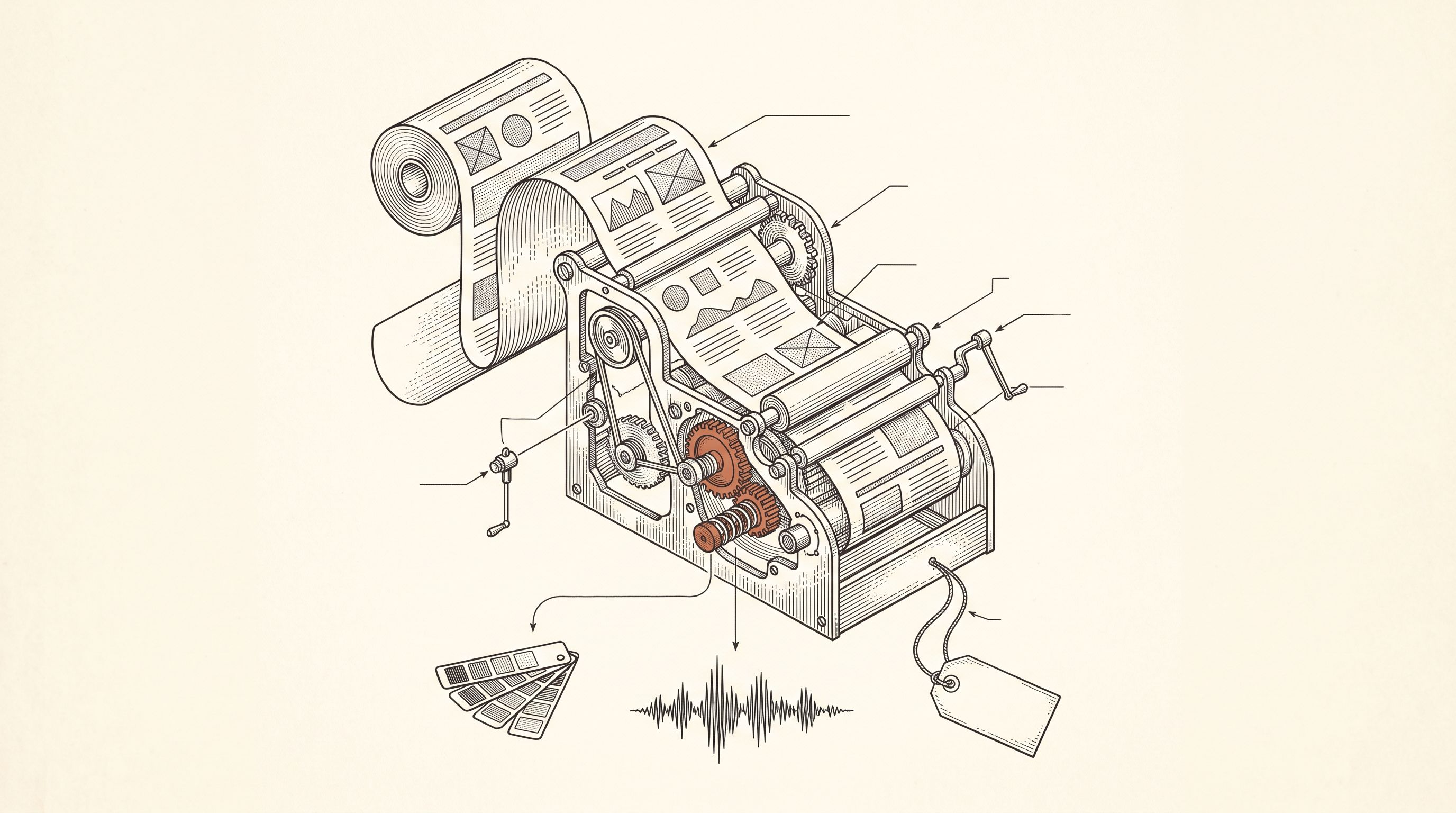
That is not the part that fails. Week four is, when the queue is empty and nothing has gone out since the last batch. Scheduling is an assembly line, and the scheduler is its last station. The five steps below cover the whole line, with the decision and the mistake at each one.

1. Where should the queue live?
The decision is not which tool has the nicest calendar. It is who holds the post between now and publish time.
Schedule inside the Instagram app or Meta Business Suite, and Instagram holds it. The post sits on Meta's servers, publishes with your phone off, and stays editable up to 75 days ahead. Whether Instagram lets you schedule at all was settled in 2022: free, and the least fragile route.
Schedule through a third-party tool, and the tool holds it. At the scheduled minute, it sends the post to Instagram through the API. Instagram accepts 25 API-published posts per account per rolling 24 hours, more than any independent needs, but the reason a bulk import fails halfway. And the permission you gave the tool expires. Instagram's long-lived tokens last 60 days unless refreshed, so "please reconnect your Instagram account" is the most common way a queue stops without telling you.
Choose the tool route for one reason only: you publish on more than one network and want one queue. Whether that tool should also write the posts is a separate question. Choose native if Instagram is your only feed.
The mistake: picking by feature list. A tool with forty features and an expired token publishes nothing.
2. What do you fix before the first post?
Fix the slots. Not the topics, not the posts. Two to four fixed slots a week, each defined by a day, a time, a format and a job.
A slot might read: Tuesday, 12:30, carousel, show one piece of work from start to finish. Another: Friday, 18:00, single image, answer one question clients ask. The topic changes every week. The slot does not.
Filling a blank calendar asks two questions per post: what to say, and when. Twelve posts, twenty-four decisions, and the "when" is the one nobody has an opinion on after a workday, so it stalls the "what". A slot template answers it once. That is what a repeating weekly plan actually removes: not the writing, the deciding.
On the time itself: pick one you can hold, not one from a chart. For an account with a few hundred followers, the hour is a rounding error next to the post itself. Fix it, and stop moving it.
The mistake: defining slots by topic ("Tuesday is tips"). A topic slot runs dry in six weeks. A job slot ("answer one client question") refills from this week's work.
The 75-day ceiling is a limit, not a recommendation. A queue built two weeks out still matches the shop it describes.
3. What does Instagram check when the post goes out?
Every scheduled post is checked at publish time against a spec you never see. Build to it once and every post passes.
The image: 1080 pixels wide, JPEG. Feed images must sit between 4:5 and 1.91:1 through the API; anything taller gets cropped. Use 4:5, the shape of the profile grid tile since Instagram moved the grid to portrait in early 2025. Instagram also recompresses every image, and third-party tools have to send JPEG in the first place. Thin type and hairlines go soft first. If scheduled graphics look blurrier than manual uploads, that is why, and the fix is heavier type, not a bigger file.
The caption: up to 2,200 characters, up to 30 hashtags, up to 20 mentions. The 31st hashtag does not get trimmed. The post fails. Roughly the first 125 characters show in the feed before "more", so the sentence that earns the tap has to finish inside them.
The carousel: up to 20 slides in the app since 2024. Some scheduling paths still stop at 10.
The mistake: fixing a failed post the morning it was due. The slot is gone. Write the spec on one line and check it before a post enters the queue.
4. How do you write a caption three weeks early?
Write it in the standing tense. A scheduled caption publishes at a moment you are not in, so it cannot describe the moment you are in now.
Open any batch-scheduled feed and you will find the tell: "Just pulled these out of the kiln" at 7pm on a Saturday, "Fresh this morning" at closing time. Nothing in Instagram's ranking cares. The reader does. A time-stamped caption landing at the wrong hour reads as automation, precisely to the customers who know your hours.
The mechanism matters if any of your captions start as AI drafts. Most captions ever written were posted live, so the default a generator learns is live immediacy: "just", "this morning", "today only". Left alone, it writes you a queue full of moments. The fix is not a rule against those words. It is a positive instruction in your brand's voice settings: open with what is always true about the work ("Every batch of this glaze comes out slightly different") instead of what is true this minute. Set once, every draft comes out schedulable.
Two more choices. Put the point in the first line, before the fold. And write for the slot's job, not the day's news; if something happens on the day, post it live, on top of the queue. The queue is the floor, not the ceiling. That is what lets Instagram posts written in your brand's voice go out on a Tuesday you spent entirely with clients.
The mistake: writing captions one at a time, on the day. Batch them in one sitting, from the slot template, and they come out consistent because they came out together.

5. How far ahead should you schedule?
Two weeks, refilled at seven days. Not 75.
75 days is the ceiling Instagram allows, and it gets read as a target. It is not. Every caption is a promise made on the day you wrote it, and reality drifts: a piece sells out, hours shift for a holiday, a price changes, the season turns. At two weeks out, almost nothing you wrote has stopped being true. At six, some has, and you will not remember which posts to check.
Two weeks also fixes the refill. A queue that empties needs a decision on a bad day, so the trigger is not "empty" but "seven days left". One week showing ahead is the signal for a fixed session, the same 30 minutes on the same day, that builds the next fortnight from the slot template. A queue that refills itself from your own site every week turns that session into a review. Either way, it is on the calendar before the queue runs low.
The mistake: scheduling everything you have. Ten posts in one afternoon feels like progress. It is ten posts and then a cliff. Two weeks and a refill day is a queue that is still running in March.
FAQ
Can you schedule Instagram posts for free?
Yes. The Instagram app and Meta Business Suite schedule at no cost. You need a professional account (Business or Creator), a free switch in settings.
How far in advance can you schedule Instagram posts?
Up to 75 days natively. Third-party tools set their own horizon. Two weeks is the distance at which captions still match what is true about your business.
Do scheduled posts get less reach than posts published live?
No. Nothing in Instagram's ranking looks at whether a post was scheduled. What lowers reach is a post nobody responds to, and a scheduled post you never come back to is exactly that.
Can you schedule carousels?
Yes, in the app and in Business Suite, up to 20 slides. Some tools still cap carousels at 10, so check before you build a longer one.
Why did my scheduled post fail?
Almost always one of three things: the tool's connection to Instagram expired, the image was outside the 4:5 to 1.91:1 range, or the caption went over 30 hashtags. Reconnect, resize or trim, and put it back in the queue.