Instagram captions for a small business, tested
Instagram captions for a small business: we tested three registers for six weeks. What survived review, and how to write yours from one real detail.
The Instagram captions that work for a small business are built on one concrete detail of the work: a number, a material, a price, a question a client asked. Not on better adjectives. We spent six weeks testing that claim against the two other ways small brands write captions, and one part of the result caught us off guard.
A word on who "we" is. We spend our days tuning AI systems that draft social captions for independent brands, which means we spend a lot of time reading and grading small-business captions. This test came out of that work.

The setup: three registers, six weeks
We keep a handful of internal test brands for tuning: a ceramist, a leather workshop, a candle maker. Small product businesses, the profile that posts its own work. For six weeks, every Instagram caption for those brands was drafted three ways:
- The marketing register. Benefit words and warm superlatives: beautiful handcrafted pieces, made with love, perfect for your home.
- The personal register. The maker talking about the journey: so proud of this one, it has been a long road.
- The detail register. One verifiable fact carries the caption: eight hours of sanding, a glaze that failed four times before it held, a batch that sold out in a weekend.
Every week, each draft faced the same question: would a busy owner publish this as-is, under their own name?
Our hypothesis going in: the personal register would win. It is what most Instagram advice recommends — show the human behind the products. We expected the marketing register to die fast, and the detail register to read a little dry.
What we expected to win, and what actually did
Half the hypothesis held. The marketing register died immediately. Those captions were easy to reject because they could describe any shop on the platform: swap the brand name and nothing breaks. Nobody needed our test to learn that.
The personal register is where we were wrong. Read alone, each of those captions felt warm and publishable. Read in a stack of thirty, they blurred into one voice. "So proud of this one" belongs to every maker on Instagram at once, which means it belongs to no one. Without an anchor, the personal register produced the most insidious kind of generic: generic that feels sincere. It survived the first read and failed the second.
The detail register won, and most weeks it was not close. A caption that opens on a glaze failing four times cannot be moved to another brand. The fact did the warmth on its own: you read persistence and craft out of it without being told what to feel.
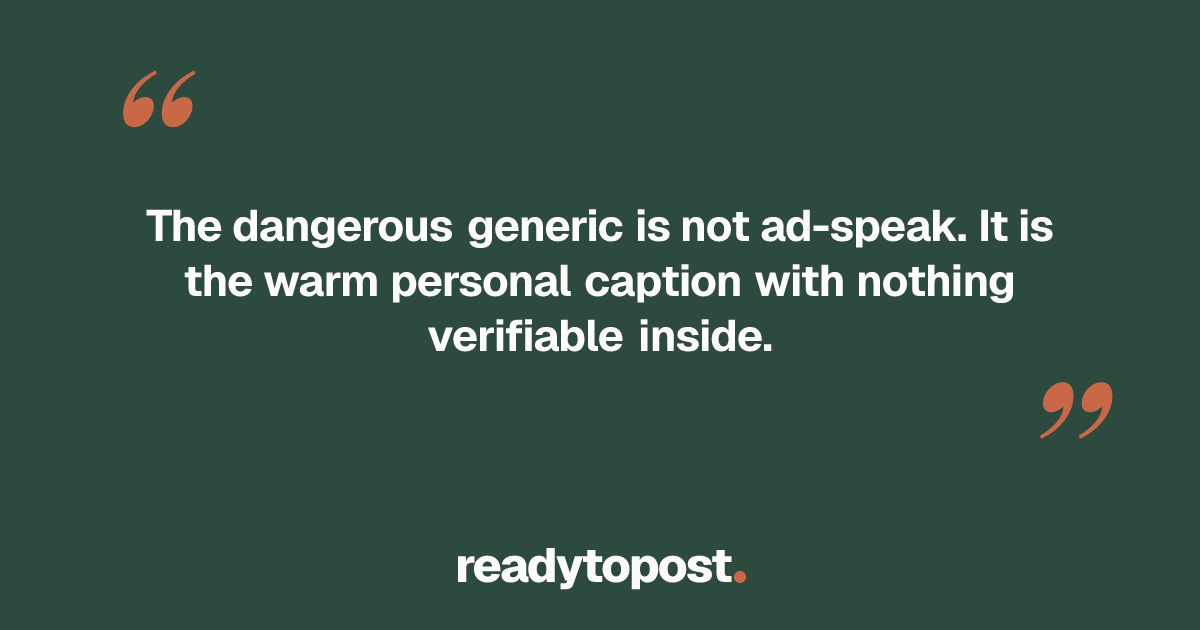
That is the observation we keep: specificity is not a style choice. It is the anti-generic mechanism itself. The dangerous generic is not ad-speak — everyone recognizes ad-speak. It is the warm personal caption with nothing verifiable inside.
A detail cannot be swapped: eight hours of sanding belongs to one workshop only.
Why one concrete detail beats better writing
Three mechanics explain the result.
The fold. Instagram cuts a feed caption after roughly 125 characters. Before that line, an adjective promises while a fact proves. "Eight hours of sanding" stops a thumb; "made with care" no longer does, because everyone writes it. Where the fold falls and what belongs above it is a subject of its own.
The profile read. Most caption reads for a small business do not happen in the feed on posting day. They happen later, when a potential customer opens the profile and reads five captions in a row, deciding whether to trust you. Five adjective captions in a row read like packaging. Five details in a row read like proof of work, accumulating.
The reply hook. A detail gives the reader something precise to answer — a client who reads about the fourth firing asks what went wrong with the first three. A warm vague caption offers nothing to grab. On an account where a single message can become an order, that difference outweighs reach.
How to write this caption for your own account
The method that came out of the test is short. Before writing a line, pick one detail from the week. Five places where one is usually waiting:
- A number from the making: hours, attempts, degrees, pieces in the batch.
- The material, and where it actually comes from.
- The price of one piece, plus one thing inside that price nobody sees.
- A question a customer asked you this week, quoted plainly.
- What changed between the first version of a piece and the one you sell now.
Then build. The detail goes in the first line, before the fold. One detail per caption: two compete, three become an inventory. The rest of the caption explains, in your normal speech, why the detail matters. Where you would have written handcrafted with care, put the hours. Where you would have written premium materials, name the tannery or the clay. The adjective becomes unnecessary once the fact that justified it is on the page. We unpack this structure further in a guide to writing a caption that sells, including what to do when the detail is a price.
One more thing our day job forces us to say. An AI drafting your captions has the same register problem you do, and the same fix. Given an empty prompt, it falls back on the register it has read most often: warm, personal, interchangeable. Given your site, your photos and your products, it can draft Instagram captions from your own details instead of everyone's adjectives. The register problem and the AI problem are the same problem.

Where the other two registers still fit
The test did not conclude that you should never be personal. It concluded: anchor first. The weeks a personal caption carried a fact inside it — almost binned the batch on Tuesday, the fourth firing saved it — that hybrid outperformed everything. Feeling attached to a fact survives the stack test. Feeling alone does not.
Even the marketing register keeps one honest slot: when the fact is the offer. A restock date, a price, a market stall this Saturday. An announcement is allowed to sell — it just has to contain the information it announces.
What we kept from the six weeks is a single review question, and we now apply it to every caption, human or machine drafted: could a competitor publish this word for word? If yes, it is not finished. It is missing its detail.
FAQ
How long should an Instagram caption be for a small business?
Length matters less than what sits above the truncation line, around 125 characters. Put the detail there. Readers who tap "more" are already evaluating you; they read long captions willingly.
Do hashtags still belong in the caption?
A few niche ones, yes. They act as search signals now, not reach levers. No hashtag rescues a first line that says nothing specific.
Can AI write captions that do not sound generic?
Yes, when it starts from your real material: your site, your products, your photos. The generic register comes from empty prompts, not from the technology itself.
What if my work has no impressive numbers?
The detail does not need to be impressive. It needs to be yours. Three colors, because the fourth never dried right, beats a big number borrowed from someone else's story.