
Instagram Marketing Plan for Coaches: A Weekly System
Build a coach-specific Instagram plan that turns one clear offer into a coherent week of useful, credible posts and invitations.
Useful visibility gives the right person a clear path from a familiar problem to a conversation.
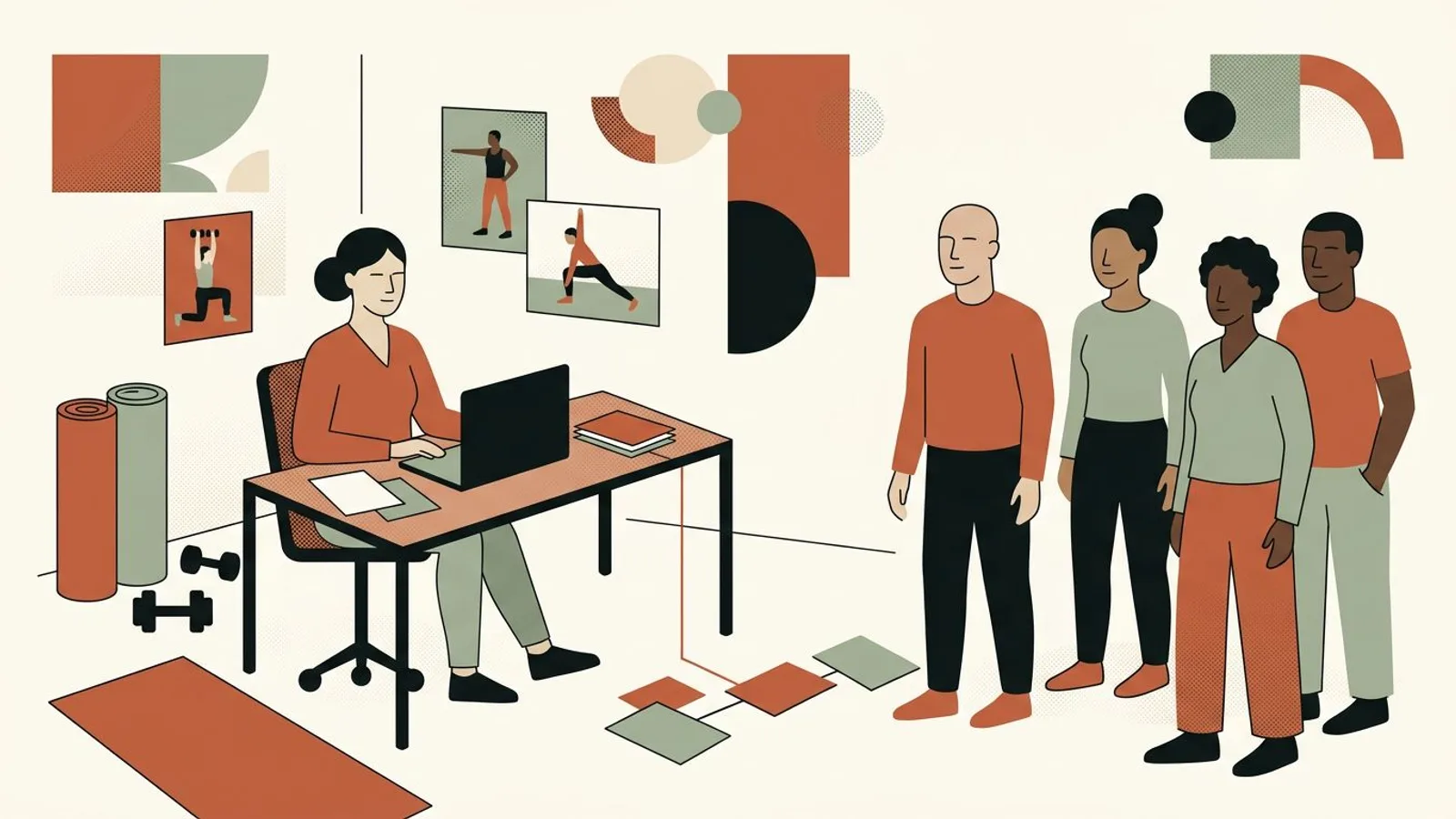
To get personal training clients online, connect one specific client problem to a clear remote offer, credible proof of how you work, and one simple intake action. Review that path every week instead of treating reach as the goal.

Want your coaching hours back?
ReadyToPost prepares a grounded week of images and captions so your working time stays focused on sessions and clients.
Reclaim my timeStart with a situation you can responsibly support at a distance, such as returning to strength training with an irregular schedule or learning to train at home with limited equipment. Define the starting point, common constraints, and scope of your coaching without promising a guaranteed or medical outcome. If your service pages already state this clearly, use them as the source for social content grounded in your website.
Write down who the offer is for, what she is dealing with now, and when another service or professional would be a better fit.
Explain what the client receives, how the initial assessment works, which parts happen live or asynchronously, how you adapt the plan, and what sits outside the service. Then trace the route from the first useful post to the intake step. If inquiries disappear along the way, read your coaching pipeline before rewriting the entire offer.
Choose one intake action, such as a short fit form or an introductory call request, and use the same name for it everywhere.

Show how you make decisions: why you adapt an exercise, what information you need before programming, how you work around common constraints, and where your coaching has limits. You can build authority without named client cases by showing your method and clearly labeling illustrative examples. Keep approved qualifications, methods, and offer facts in a brand knowledge base, then support them with your own photos and brand-aligned AI visuals.
Before publishing, ask what a prospective client can verify about your judgment from this specific piece.
Begin with one real question and adapt its presentation to each network while keeping the client problem, offer, and intake action consistent. On Instagram, a useful visual can lead into a concise caption; LinkedIn can unpack a professional decision; Facebook can add context; Pinterest can organize a reference; and X can condense one practical point. The format changes, but the promise does not.
Plan related ideas together. The case for planning ahead instead of living post to post is that you can spot gaps and repetition before publishing.
Review each transition in order: whether the right people recognize the problem, visit the offer, understand the service, and complete the intake action. Change the weakest transition first and leave the rest stable long enough to interpret what you observe. A social media planner and content calendar can keep the prepared week available for review and scheduling without competing with client sessions.
Track questions and qualified inquiries alongside reach. Reach provides context; it does not tell you whether the client path is clear.
What if your proof looked unmistakably yours?
Turn your real methods, brand facts, and photos into a recognizable presence instead of interchangeable fitness content.
Sharpen my proofDo
Don't

Situation
Illustrative example: a personal trainer offers remote support for people returning to home strength training, but her posts alternate between advanced workouts, general motivation, and unrelated nutrition tips. Her profile points to several services with no clear remote option.
Action
She centers the offer and content on returning to strength training at home with an irregular schedule. She explains the remote assessment, shows how she adapts sessions to common constraints, and directs each relevant piece to the same short fit form.
Outcome
In this illustrative scenario, the path becomes easier to understand: a prospect can recognize her situation, assess the trainer's method, understand the remote offer, and know how to inquire. This describes structural clarity, not a measured or guaranteed acquisition result.
Your week can keep a recognizable rhythm
ReadyToPost adapts one coherent batch to five supported networks and prepares it for your review and calendar.
A widely viewed post may reach people who would never need your service. Check whether the problem resonates with the people who visit the offer and submit useful context, not only how many reactions the post receives.
A testimonial does not explain how you made a decision or whether the service fits another person. Use authorized feedback with appropriate context, and also show your method, professional judgment, and boundaries.

If one post asks people to comment, send a message, visit several pages, download a resource, and book a call, the route is hard to follow. Choose the intake action that gives you the information needed to assess fit.
A method is set — still, you need time to put it to work. Readytopost frees that time by taking one front off your plate: your presence on the five social networks. Everything written, illustrated, scheduled — calibrated on your work, week after week. So your energy stays on the trade.
Start with ReadyToPostSee how these principles play out day to day. Practice for independent coaches gives you concrete, illustrated, adaptable levers — directly applicable the following week. No quarterly plans, no annual roadmaps: weekly gestures that touch something right away.
See it in practice
Start where people with the specific problem you serve already look for help: search, relevant communities, and the networks you can maintain well. You do not need every channel. You need each chosen channel to present the same offer and lead to a clear intake action.
Useful content makes your judgment visible around a specific problem. Explain how you adapt an exercise, what you assess before programming, which mistakes you correct, and where your coaching has limits. Ground it in your own methods and material rather than generic motivation or unsupported transformations.
Testimonials are not required to explain your competence. If you have authorized feedback, present it with enough context and do not extend what it claims. Without testimonials, show your method, decisions, boundaries, qualifications, and clearly labeled illustrative examples.
Define an observable signal for each transition: relevant people engaging with the problem, visits to the offer, intake starts, qualified inquiries, and scheduled conversations. Look for patterns rather than attributing a result to one week, and change one transition at a time.
Build a coach-specific Instagram plan that turns one clear offer into a coherent week of useful, credible posts and invitations.

You do not need an audience to sign your first coaching clients. You need one clear sentence, an activated first circle, and just enough public proof. Here is the five-step method.

You don't win premium clients with more reach — you win them by making your content speak to one costly problem and prove the depth behind your fee. Here is the method.
Most coach bios promise a transformation but hide the method. Use one client, one change and one observable way of coaching to make yours specific.
Nine notes from a year of watching coach accounts on Instagram: the posts that book discovery calls, the ones that only collect saves from other coaches, and what to publish the week nothing happened.
A fitness coach answers 8 to 12 post-worthy client questions a week, out loud, and loses them. This walkthrough turns one logged week into a month of posts.

From a single website URL, ReadyToPost builds your brand profile and starts generating on-brand posts — no manual brief to fill.

Create AI product images and social media visuals from your photos or from scratch. ReadyToPost applies your brand style in the right format for each network.

A semantic memory of your brand's real facts, so every post cites what you actually do and have.
Generate on-brand Instagram posts where the 4:5 feed visual and the caption are built together — a scroll-stopping hook, breathable paragraphs, and full-word hashtags grouped at the end, scheduled and ready to publish.
ReadyToPost prepares LinkedIn posts in your voice every week. Review and approve your content, then publish to your profile or company page on schedule.
ReadyToPost prepares Facebook images and posts in your voice every week. Review and approve them, then schedule publication to your Facebook Page.
You hold the principles. Readytopost takes the communication off your plate, every week — so your method stays your method.
Monthly plansReady in minutesCancel in one click